
Last updated September 3, 2026
The Complete Guide to Chimney Cleaning in Bridgeport
More than 60% of Bridgeport’s housing units were built before 1960, which means a large share of local chimneys were designed for fuel types no longer in use — and most owners have no idea what’s actually lining their flue. We’ve pulled apart flues in Black Rock, removed collapsed liners in the Hollow, and found oil-to-gas conversion residue caked inside systems that homeowners assumed were “clean” because they burned gas now. This guide explains what chimney cleaning actually involves in Bridgeport’s specific conditions: how coastal salt air changes deterioration timelines, why your 1920s Triple-Decker chimney needs different care than a 1990s ranch, and how to read a cleaning report so you know what’s urgent and what’s a sales pitch.
Quick Answer
Professional chimney cleaning in Bridgeport, CT typically costs $200–$400 for a standard sweep with Level 1 inspection, takes 45–90 minutes, and should happen annually for wood-burning systems or every two years for gas. Because Bridgeport’s pre-1960 housing stock often contains unlined flues, damaged mortar from salt-air exposure, or oil-to-gas conversion residue, a basic sweep frequently reveals conditions that require a Level 2 inspection with a camera — adding $150–$300 but potentially preventing a chimney fire or carbon monoxide leak. For homeowners navigating this process, our How to Hire a Chimney Cleaning Contractor in Bridgeport: A Step-by-Step Guide explains what to ask before booking.
Table of Contents
- Why Bridgeport Chimneys Are Different
- What Actually Happens During a Professional Chimney Cleaning
- Level 1 vs. Level 2 vs. Level 3 Inspection: Which One Do You Need?
- The Hidden Problem in Bridgeport: Oil-to-Gas Conversion Residue
- How Bridgeport’s Coastal Salt Air Destroys Chimneys Faster
- How to Read a Chimney Cleaning Report (Without Getting Upsold)
- What Chimney Cleaning Costs in Bridgeport
- Common Mistakes to Avoid
- When to Call a Professional
- Frequently Asked Questions
Why Bridgeport Chimneys Are Different
Bridgeport isn’t Fairfield County new construction. It’s Connecticut’s largest city by housing density, with a building stock that spans 1880s wood-frame Triple-Deckers in the East End, 1920s Colonials in Black Rock, mid-century brick ranches in North End, and scattered post-war capes in Brooklawn. Each era carries distinct chimney risks that a generic “annual sweep” doesn’t address.
Triple-Decker and pre-WWII housing (common in East End, West End, Hollow, South End): These chimneys were typically built with unlined brick flues, sized for coal or oil combustion. When owners converted to gas — which happened across Bridgeport in waves from the 1950s through the 1980s — the flue often went unlined or received a cheap clay liner that has since cracked. The National Fire Protection Association (NFPA) now requires gas appliances to vent through properly sized, intact liners. An unlined or damaged flue in a gas conversion chimney can allow carbon monoxide to seep through deteriorated mortar joints into living spaces — especially dangerous in multi-family buildings where one flue serves multiple units.
Colonial and Cape construction (Black Rock, Brooklawn, parts of North End): These often have exterior masonry chimneys exposed to Bridgeport’s coastal weather on three sides. The freeze-thaw cycle here is more aggressive than inland Connecticut because salt air accelerates moisture absorption into mortar. We’ve repointed chimneys in Black Rock that needed crown replacement after just six years — the same construction in Danbury or Waterbury typically lasts twelve to fifteen.
Post-1970s construction: Even newer homes aren’t immune. Factory-built metal chimneys from the 1980s and 1990s have reached end-of-life for many components. The galvanized chase covers used in that era rust through predictably, and we’ve replaced dozens in North End subdivisions where water damage was misdiagnosed as “a leak” rather than chimney component failure.
Key point: Bridgeport’s housing diversity means there’s no standard chimney. The cleaning that suffices for a 2005 fireplace insert in Fairfield might miss critical safety issues in a 1910 East End flue.
What Actually Happens During a Professional Chimney Cleaning
A proper chimney sweep isn’t a vacuum-and-go operation. Here’s what happens when Anthony leads a cleaning job in Bridgeport — and what you should expect from any technician you hire.
- Pre-job inspection and protection: We lay drop cloths, seal the fireplace opening with a HEPA vacuum connection, and inspect the exterior for obvious damage before touching anything inside. In Bridgeport’s older homes, we’re also checking for signs of previous DIY work — we’ve found wire mesh stuffed up flues, inappropriate flex pipe forced into masonry chimneys, and even cardboard “seals” that previous owners installed to stop drafts.
- Mechanical sweeping of the flue: Using rotating brushes sized to your flue diameter — poly for metal liners, stiff wire for masonry — we dislodge creosote, soot, and debris from the flue walls. For heavy creosote buildup (common when homeowners burn unseasoned wood or restrict airflow), we apply ACS anti-creosote treatment before mechanical cleaning.
- Smoke chamber and firebox cleaning: The area above the damper and the firebox itself collect ash, soot, and deteriorated masonry particles. We hand-scrape the smoke chamber to remove glaze creosote — the hardened, tar-like deposit that mechanical brushes often miss.
- Component inspection: Damper operation, firebrick condition, lintel integrity, and throat sealing all get checked. In Bridgeport’s converted systems, we’re specifically looking for proper gas appliance venting connections — a common failure point we find in pre-1960 chimneys.
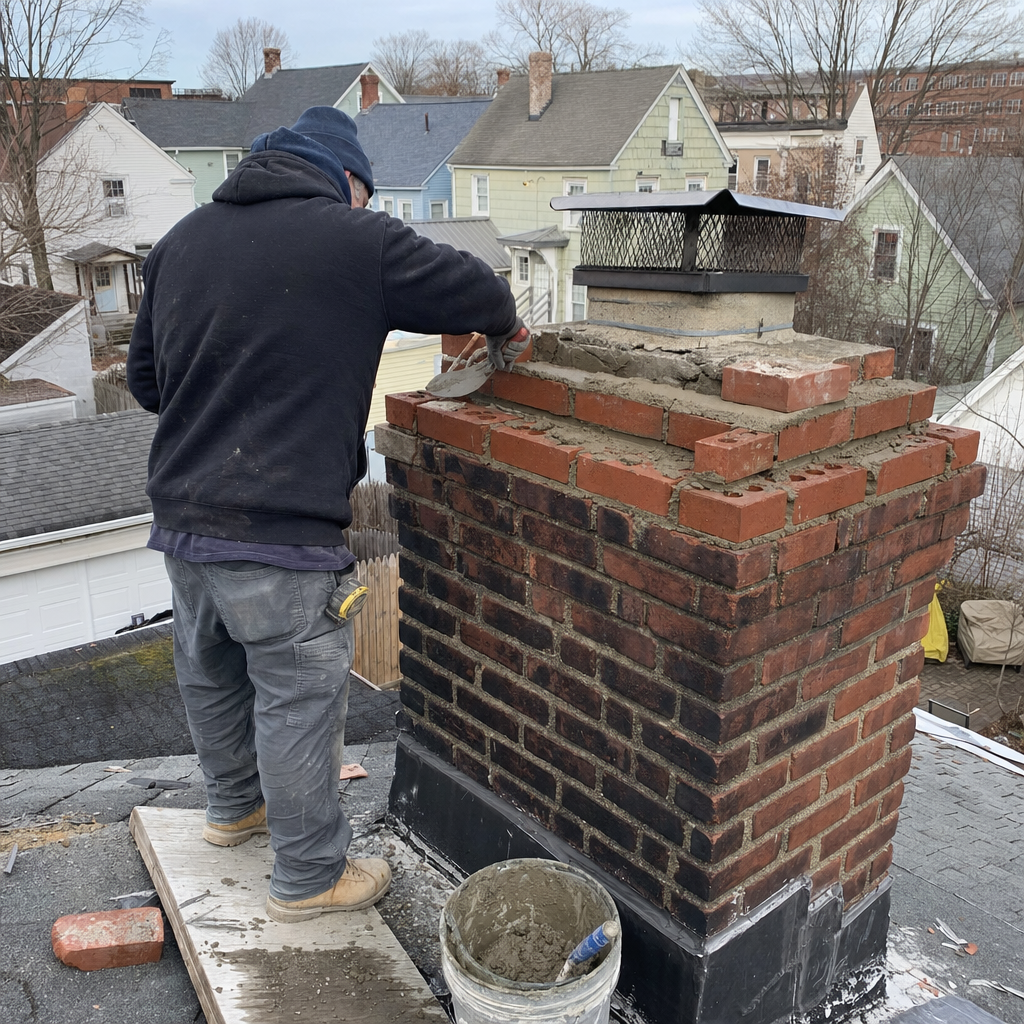
- Exterior examination: Crown, cap, flashing, and visible mortar joints. If we spot spalling brick, missing mortar, or crown cracks, we document with photos for the report.
- Cleanup and documentation: HEPA vacuuming of all work areas, removal of debris, and a written report with findings and recommendations.
Total time: 45 minutes for a well-maintained system, up to 2.5 hours for a first cleaning on a neglected chimney with heavy buildup or damage discovery.
Level 1 vs. Level 2 vs. Level 3 Inspection: Which One Do You Need?
The NFPA 211 standard defines three inspection levels, and most Bridgeport homeowners don’t know which applies to them — or when a sweep is trying to sell an unnecessary upgrade.
| Inspection Level | What It Includes | When You Need It | Typical Bridgeport Cost |
|---|---|---|---|
| Level 1 | Visual examination of readily accessible portions of chimney exterior and interior, plus appliance connections and basic clearances. No tools required to gain access. | Annual maintenance on a system with no changes — same appliance, same fuel, no known problems. | Included in standard sweep ($200–$300) |
| Level 2 | Everything in Level 1, plus video scan of interior flue surfaces, accessible portions of attic and basement, and inspection of clearances to combustibles in concealed spaces. | Property sale/transfer; new appliance installation; fuel conversion; after chimney fire or weather event; or when Level 1 reveals suspected damage. | $350–$550 (often bundled with cleaning) |
| Level 3 | Destructive inspection — removal of building materials (wall sections, chimney surrounds) to access concealed areas when serious hazard is suspected but cannot be confirmed otherwise. | After a chimney fire with suspected hidden damage; structural failure investigation; or when Level 2 indicates concealed damage requiring verification. | $800–$2,500+ depending on access work needed |
Bridgeport-specific guidance: If your home was built before 1960 and you’ve never had a video inspection, you need Level 2 — not because we’re upselling, but because unlined flues, hidden mortar deterioration, and improper gas conversion venting simply cannot be evaluated visually. We’ve found cracked clay liners in Black Rock Colonials that looked fine from the firebox but were spalling dangerously at the first offset. The $150–$250 add-on for video inspection has prevented multiple carbon monoxide exposures we’ve caught before they became emergency calls.
Conversely, if a company recommends Level 3 without clear evidence of concealed damage from Level 2, get a second opinion. Level 3 involves cutting into your structure; it should never be a first suggestion.
The Hidden Problem in Bridgeport: Oil-to-Gas Conversion Residue
Bridgeport’s heating history tracks the Northeast’s energy transitions: coal through the 1940s, heating oil dominant through the 1970s, then accelerating gas conversions driven by oil price spikes and utility incentives. Many of those conversions — especially in the 1980s and 1990s — were done by HVAC contractors who understood boilers but not chimneys.
What conversion residue looks like: When an oil-fired appliance vents through a masonry flue, it deposits sulfur-laden condensation that combines with flue gases to form sulfuric acid. Over years, this etches mortar joints and saturates the masonry. When gas is later vented through the same flue — producing much lower temperatures and higher moisture content — that acid-weakened masonry fails faster. The residue itself appears as white or gray powdery deposits (efflorescence and sulfate salts), black tar-like glazing near the top of the flue, and in severe cases, mortar that crumbles to the touch.
Why standard sweeping doesn’t fix it: Mechanical brushes remove loose material but don’t neutralize acid damage or restore mortar integrity. We’ve cleaned flues in the Hollow that passed a basic sweep — no blockage, no heavy creosote — but had mortar joints so deteriorated that a gas water heater was venting into wall cavities. The homeowner smelled nothing because CO is odorless.
What proper remediation involves: Video inspection to assess liner condition; pH testing of masonry where accessible; and either stainless steel liner installation (we typically spec DuraFlex or Olympia Chimney products for their corrosion resistance) or HeatShield cerfractory resurfacing for liners with localized damage. In Bridgeport’s Triple-Deckers with multiple appliances sharing a flue, we often need to separate venting with individual liners — a code requirement since 2015 that many older buildings still haven’t met.
If your home converted from oil to gas and you’ve never had a post-conversion chimney evaluation, the “cleaning” you need is diagnostic first, mechanical second.
How Bridgeport’s Coastal Salt Air Destroys Chimneys Faster
Bridgeport sits on Long Island Sound with an average elevation under 50 feet. The salt-laden maritime air — measurable in chloride deposition rates higher than Hartford County by a factor of three — creates specific deterioration patterns that inland chimney guides never mention.
Crown failure accelerated: Concrete chimney crowns absorb moisture through capillary action. Salt ions in that moisture accelerate freeze-thaw spalling. We’ve replaced crowns in Seaside Park-adjacent homes after four years that would last ten in Torrington. A proper crown in Bridgeport needs specific characteristics: minimum 2-inch overhang beyond the chimney face, drip edge underneath, and a cementitious formulation rated for marine exposure — not the standard mortar mix many builders use.
Flashing corrosion: Standard galvanized step flashing rusts through predictably in salt air. We use Copperfield copper or lead-coated copper flashing for Bridgeport installations — higher initial material cost, but we’ve never had a callback on properly installed copper flashing in eight years.
Metal component degradation: Chimney caps, chase covers, and damper frames all corrode faster. The cheap galvanized caps sold at hardware stores? We’ve replaced dozens that failed within three years. Gelco stainless steel caps with proper mesh sizing for our local bird populations (starlings and sparrows are particular problems in Bridgeport’s dense neighborhoods) are what we specify.
Mortar joint erosion: Salt crystallizes in mortar pores, exerting pressure that exceeds the mortar’s tensile strength. Type N mortar — standard for above-grade masonry — deteriorates visibly in Bridgeport within a decade on exposed chimneys. When we repoint, we use Type S with air-entrainment additives, and we press for full-depth joint removal rather than surface “tuckpointing” that hides deterioration.
The practical implication: Bridgeport chimneys need more frequent exterior inspection than inland equivalents. A cleaning visit is the right time to catch crown, cap, and mortar issues before water infiltration requires rebuild-level intervention. Our Seasonal Chimney Cleaning Care for Bridgeport: Year-Round Homeowner’s Guide outlines when to schedule these checks.
How to Read a Chimney Cleaning Report (Without Getting Upsold)
After cleaning, you should receive a written report with findings and recommendations. Here’s how to evaluate whether what you’re reading is legitimate safety concern, preventive maintenance, or unnecessary upsell — using language we’ve actually seen on competitor reports in Bridgeport.
Red-flag language that demands skepticism:
- “Urgent” or “immediate danger” without photo documentation or specific code reference. Real hazards get specifics: “NFPA 211 Section 11.2 requires liner replacement when gaps exceed 1/2 inch — video scan at 14:32 shows 3-inch gap.”
- Vague recommendations like “needs repair” without defining which component, what failure mode, and what standard applies.
- Pressure to decide immediately. Legitimate safety issues merit prompt attention, but you can always request a second opinion or time to review.
How to categorize what you’re told:
| Category | What It Means | Typical Examples | Timeline |
|---|---|---|---|
| Urgent (safety hazard) | Active risk of fire, CO poisoning, or structural failure. Use of system should stop until repaired. | Blocked or collapsed flue; visible flame impingement on combustibles; CO readings above ambient in living space; detached gas vent connector. | Before next use |
| Preventive (deferred maintenance) | Condition will become hazardous if uncorrected, but system is safe for limited use with monitoring. | Crown cracking without water entry; early-stage mortar erosion; damper corrosion with partial function; minor flue tile cracking without gap formation. | Within 6–12 months |
| Improvement (optional upgrade) | Enhances performance, efficiency, or longevity but isn’t required for safe operation. | Cap installation for debris prevention; top-sealing damper for energy efficiency; fireback installation for radiant heat. | When budget allows |
Bridgeport-specific report elements to demand: Documentation of liner material and condition (critical for pre-1960 homes); confirmation that gas vent connectors are properly sized and supported; and exterior photo documentation of crown, cap, and visible mortar — because salt-air deterioration is predictable and progressive, and you want baseline documentation for comparison at next cleaning.
At Premier Chimney Cleaning Connecticut home, Anthony includes video scan footage with every Level 2 report and explains findings before any recommendation. If a competitor won’t show you what they’re describing, that’s information you should weigh heavily.
What Chimney Cleaning Costs in Bridgeport
Pricing varies with chimney type, accessibility, and condition — not just by zip code. Here’s what we’ve charged and seen quoted across Bridgeport neighborhoods for actual completed jobs.
| Service | Bridgeport Price Range | What Affects Cost |
|---|---|---|
| Standard sweep + Level 1 inspection (gas fireplace or insert, good maintenance history) | $200–$280 | Roof access difficulty; number of flues; appliance type |
| Sweep + Level 2 inspection with video scan (pre-1960 home, first cleaning, or property sale) | $350–$450 | Flue length and bends; number of appliances; accessibility of cleanout |
| Heavy creosote removal (glaze stage, neglected wood-burning system) | $400–$600 | Degree of buildup; chemical treatment cycles needed; time on site |
| Chimney cap installation (stainless steel, standard size) | $350–$550 | Flue diameter; cap style (single-flue vs. multi-flue); roof access |
| Crown repair/rebuild (minor crack sealing vs. full pour) | $400–$1,200 | Crown size; damage extent; need for formwork |
| Stainless steel liner installation (single appliance, standard height) | $2,800–$4,500 | Liner diameter and length; appliance type; connection complexity; whether chase modification needed |
What drives Bridgeport costs specifically: Triple-Decker roof access often requires ladder work that simpler ranch homes avoid; pre-1960 chimneys frequently need cleanout door installation or enlargement for proper tool access; and multi-family buildings may require coordination with tenants that extends time on site.
We provide upfront written estimates before starting any work beyond the agreed scope. Call (833) 719-7193 for exact pricing on your specific chimney — estimates are free.
Common Mistakes to Avoid
- Hiring based on lowest quote alone. In Bridgeport’s market, we’ve corrected work from sweeps who missed unlined flues, installed improperly sized caps, or “cleaned” without actually accessing the flue. The $89 special often skips inspection entirely — and in a pre-1960 chimney, no inspection means no knowledge of what you’re burning into.
- Assuming gas doesn’t need cleaning. Gas appliances produce different deposits than wood — water vapor, sulfur compounds, and in older systems, rust particles from deteriorated connectors. These can block flues and corrode liners. “I burn gas so I don’t need service” is a dangerous assumption we’ve seen lead to CO incidents in Brooklawn and North End.
- Ignoring the exterior until water appears inside. By the time you see ceiling staining, water has already degraded mortar, rusted metal components, and potentially damaged framing. Bridgeport’s salt air means exterior deterioration runs faster than visual intuition suggests — especially on south- and west-facing chimney exposures.
- DIY cleaning with hardware-store brushes. The wrong brush diameter or stiffness damages flue tiles. Worse, without video inspection you have no idea if your “clean” flue has hidden cracks or missing mortar. For wood-burning systems with any stage of creosote buildup, professional removal is safer — glaze creosote requires chemical treatment and mechanical removal that homeowner tools can’t achieve.
- Neglecting post-cleaning recommendations. We issue recommendations because conditions progress. The crown crack that’s “not leaking yet” in October often becomes active water entry by March after freeze-thaw cycles. Deferred maintenance in Bridgeport’s climate has a cost multiplier.
- Failing to verify what’s in your flue before a home sale. Bridgeport’s competitive real estate market means buyers increasingly request Level 2 inspections. Discovering liner problems during buyer due diligence — when you’re under contract pressure — costs more and creates transaction friction. Pre-listing inspection lets you address issues on your timeline.
When to Call a Professional
Call before small problems become expensive ones. Specifically: if you smell smoke in rooms adjacent to the chimney; if your damper sticks or won’t fully open or close; if you see white staining on exterior brick (efflorescence signaling water infiltration); if your fire “smokes back” into the room; if you’ve never had service and your home is pre-1960; or if you’re converting fuel types or installing a new appliance.
Any of these scenarios in a Bridgeport home warrants evaluation by someone who understands the local housing stock — not a generalist handyman or a sweep who drives through from another county twice a year. Anthony Perez has spent eight years diagnosing chimney conditions specific to Bridgeport’s building eras and coastal environment. Chimney Cleaning & Sweep in Hartford and surrounding areas is also available through Premier Chimney Cleaning Connecticut.
Premier Chimney Cleaning Connecticut offers free estimates in Bridgeport — call (833) 719-7193.
Frequently Asked Questions
A standard chimney sweep with Level 1 inspection in Bridgeport typically runs $200–$400, depending on flue accessibility, number of flues, and whether the system has been maintained regularly. Pre-1960 homes often need a Level 2 video inspection, which adds $150–$300 but identifies liner and mortar conditions that visual inspection misses. Call (833) 719-7193 for a free exact quote on your specific chimney.
Wood-burning systems need annual cleaning per NFPA 211 — more frequently if you burn unseasoned wood or use the fireplace as primary heat. Gas systems should be inspected every two years, though we recommend annual checks for pre-1960 chimneys due to conversion residue and liner deterioration risks. In Bridgeport’s coastal environment, exterior components (crown, cap, flashing) merit visual inspection during every cleaning visit.
A sweep is the mechanical cleaning of flue surfaces and firebox. An inspection is the evaluation of system condition, clearances, and code compliance. They’re related but distinct — a sweep without inspection tells you nothing about hidden damage; an inspection without cleaning may miss how buildup affects draft and safety. Professional service in Bridgeport should include both, with inspection level matched to your system’s age and history.
Mechanical brushing of a straightforward masonry flue is physically possible for a homeowner with proper tools, but we don’t recommend it for Bridgeport’s housing stock. Pre-1960 chimneys frequently contain unlined flues, improper gas conversions, or deteriorated mortar that DIY cleaning cannot assess and may worsen with incorrect brush selection. For any system with glazed creosote, stainless steel liner, or suspected damage, professional service is the safer choice — and for gas appliances with venting concerns, it’s the only responsible one.
Smoke odor when the fireplace isn’t in use typically indicates downdraft pulling air down the flue — common in Bridgeport’s dense neighborhoods where surrounding buildings alter wind patterns — or negative pressure from exhaust fans (kitchen, bath, dryer) drawing air through the chimney path. It can also signal creosote buildup or animal nesting. A top-sealing damper or proper chimney cap often resolves downdraft; persistent odor with a gas system requires immediate inspection for venting problems.
Modern codes require proper venting for all gas appliances, which in a masonry chimney typically means a listed liner sized to the appliance. Many Bridgeport conversions from the 1970s–1990s were done without liners, creating potential for condensation damage, CO leakage through deteriorated mortar, and draft problems. If your conversion predates liner requirements, a Level 2 inspection is essential to determine what venting you actually have — not what you assume was installed.
Legitimate reports include specific findings with photo or video documentation, reference applicable codes (NFPA 211, IRC Chapter 10), and categorize recommendations by urgency. Be skeptical of “urgent” language without specifics, pressure to decide immediately, or recommendations that don’t match your system’s fuel type and usage. At Premier Chimney Cleaning Connecticut, Anthony reviews every report with homeowners before any work beyond the agreed scope — transparency that 800+ reviews at 4.7 stars suggest our customers value.
The Bottom Line
Chimney cleaning in Bridgeport isn’t a commodity service — it’s diagnostic work that must account for your home’s construction era, fuel history, and coastal environment. The pre-1960 housing stock that defines much of the city carries specific risks (unlined flues, conversion residue, salt-air deterioration) that generic sweeping misses. A proper cleaning includes appropriate inspection level, honest reporting with documentation, and recommendations categorized by actual urgency rather than sales pressure. Whether you’re maintaining a well-kept system or discovering what decades of deferred attention have accumulated, starting with accurate knowledge of what’s in your flue is the only safe foundation. Explore our more guides & resources for ongoing chimney maintenance advice.
Written by Anthony Perez, Owner & Lead Technician at Premier Chimney Cleaning Connecticut, serving Bridgeport since 2018.