
Chimney Cap Installation Cost in Connecticut: $150–$700 Depending on Flue Setup and Material
Most Chimney Cap & Crown installations in Connecticut run between $150 and $700, with single-flue caps starting around $150–$350, multi-flue caps at $300–$600, and top-mount damper caps landing in the $400–$700 range. The final price depends on your flue configuration, roof access, and whether you’re matching the cap to Connecticut’s coastal salt air or inland debris loads. Call (833) 719-7193 for a free, exact quote — Anthony Perez, our owner and lead technician, measures every job personally.
Why Cap Selection in Connecticut Is a Draft Engineering Decision, Not a Cosmetic Choice
We’ve pulled caps off chimneys in Milford, New Haven, and Hartford County that were actively making the fireplace worse. A cap with the wrong screen height, the wrong lid profile, or the wrong mounting method for a multi-flue stack can choke draft exactly when you need it — during that first cold snap when the house is freezing and the fire won’t draw.
Connecticut’s wind patterns don’t help. The shoreline sees steady onshore flow off Long Island Sound, while inland valleys and ridge-top homes in Litchfield County get swirling, unpredictable gusts. A cap that works fine in a sheltered suburban lot in West Hartford can be a draft nightmare on an exposed hill in Cornwall. We’ve learned this the hard way over eight years, one specialty — Anthony’s replaced caps that other contractors installed without ever testing the draw.
That’s why we treat cap selection as technical work, not an add-on sale. Anthony leads every job, and he’s the one who comes back if the draft doesn’t feel right. No subcontractor, no handoff.
The Three Cap Types, What Each Actually Does to Your Draft, and What We Charge
Most cost pages list cap types without explaining how each one interacts with your flue system. Here’s what we’ve learned installing them across Connecticut:
- Single-flue caps mount directly to the tile or flue liner. They’re the simplest, but the screen clearance matters enormously — too tight, and smoke backs up into the room; too loose, and squirrels get in. We see these most on 1960s–1980s colonials in suburbs like Wallingford and Cheshire.
- Multi-flue caps cover the entire chimney top, usually with legs that straddle the crown. They’re essential when two or three flues exit the same chase, common in larger homes in Greenwich, Darien, and older Farmington Valley builds. The wrong multi-flue cap creates cross-drafts between flues — one flue can actually siphon smoke from another.
- Top-mount damper caps combine a cap with a damper mechanism that seals the flue at the top instead of the throat. They save energy and stop heat loss, but the damper must be precisely matched to the flue diameter. We’ve found these especially useful in shoreline cottages where owners want to close the flue tight against salt air infiltration during off-seasons.
| Cap Type | Typical Cost Range (Installed) | Best For |
|---|---|---|
| Single-flue cap (galvanized) | $150–$250 | Budget installs, short-term solutions |
| Single-flue cap (stainless steel) | $250–$350 | Standard Connecticut install, 10–15 year lifespan |
| Multi-flue cap (stainless steel) | $300–$600 | Multiple flues, larger crowns |
| Top-mount damper cap | $400–$700 | Energy efficiency, tight sealing, older fireplaces |
| Copper custom cap | $600–$1,200+ | Historic homes, aesthetic matching |
These ranges include removal of the old cap, proper fitting, and verification that the draft pulls correctly before we leave. We don’t quote over the phone without seeing the flue — anyone who does is guessing, and guessing is how you end up with a cap that starves your fire.
Connecticut’s Climate Zones and What They Mean for Cap Material
The cap that lasts in Stonington won’t necessarily last in Torrington. We plan for two distinct corrosion and debris environments:
Coastal and shoreline communities — from Old Saybrook west to Greenwich and up the Housatonic shore — face salt air that destroys galvanized steel in three to five years. We’ve pulled rusted-through caps off Milford and Stratford chimneys that looked fine from the ground but were sieve-holes up close. For these homes, we specify stainless steel minimum, and we source from Gelco and Famco product lines with heavier gauge metal and proper salt-air-rated finishes. Copper holds up beautifully here too, but it’s an investment.
Inland wooded areas — the Litchfield Hills, eastern Connecticut oak forests, neighborhoods in Mansfield and Hebron — see massive leaf, acorn, and seed debris loads every fall. A cap with inadequate mesh or poor lid overhang clogs fast, and a clogged cap is just a blocked flue waiting to happen. We size the screen and lid projection specifically for the tree canopy density around your chimney. Anthony grew up in New Haven’s Fair Haven neighborhood and spent his twenties figuring out that working with his hands suited him better than a desk job; he’s seen what Connecticut’s seasons do to metal up close.
The wrong material choice doesn’t just mean replacing the cap sooner. It means the cap fails quietly — rust holes let water in, debris accumulates, freeze-thaw cracks the crown — and you don’t know until the water damage shows up inside.
The Hidden Cost Nobody Puts in Their Price: Water Damage From Poor Installation
Here’s the number that should change how you think about cap cost. A poorly fitted cap, or a cap installed on a crown that’s already cracked, lets water into the flue system. Within two winters in Connecticut’s freeze-thaw cycle, that water does $800–$2,000 in damage to the firebox, smoke chamber, or liner. We’ve seen it repeatedly — caps that looked “fine” but had a 1/8-inch gap at the mount, or were caulked with hardware-store silicone that cracked by January.
This is why we don’t separate Chimney Crown Repair Cost in Connecticut, CT from installation quality. When Anthony measures your flue, he’s also checking crown condition, flue tile integrity, and whether the chase needs waterproofing. If the crown is deteriorated, we’ll tell you — not to upsell, but because a $300 cap on a failed crown is money thrown away. We’d rather give you the straight answer on the roof than a comfortable one at the bottom of the ladder.
We use Gelco and Famco caps — actual chimney-industry product lines, not hardware-store units — because the gauge of the metal, the consistency of the mesh weld, and the precision of the mounting hardware actually matter when you’re tapping into masonry that has to survive Connecticut winters. The fit is tighter. The fasteners are proper stainless. The lid doesn’t rattle loose in March wind.
Common Local Scenarios: What Connecticut Homeowners Actually Ask Us
These are the situations we encounter regularly, and what they typically cost:
The 1970s center-hall colonial with one flue and a deteriorated galvanized cap. Common in Bristol, Plainville, Southington. We remove the rusted cap, inspect the flue tile for spalling, install a stainless single-flue cap with proper screen height. Usually $250–$350. If the flue tile top is cracked, we may need a flue top repair first — adds $150–$300.
The 1890s–1920s multi-flue stack on a converted furnace chimney. We see these in New Haven’s East Rock, Hartford’s West End, older Bridgeport neighborhoods. Two or three flues, often irregular spacing, crown that’s been patched multiple times. Requires custom-measured multi-flue cap, sometimes with leg extensions. $400–$600. Crown rebuild if needed: additional $500–$1,200.
The shoreline second-home with a throat damper that’s rusted open. Stonington, Mystic, Madison, Fairfield beach areas. Owner wants to stop heating the neighborhood. Top-mount damper cap seals the flue at the top, eliminates the rusted throat damper from the equation. $500–$700. The energy payback is usually one heating season.
The “I bought a cap at Home Depot and my contractor put it on” callback. We’ve done dozens of these. The cap is too small, the screen is wrong for the appliance (wood stove vs. fireplace require different clearances), or it’s mounted with improper fasteners that loosened. We remove, dispose, and install properly. Sometimes the DIY cap is salvageable; often it’s not worth reusing. $200–$400 depending on what we’re fixing.
What Our Process Looks Like — From Call to Cap
When you call (833) 719-7193, Anthony schedules a time to see the chimney personally. No satellite-photo estimates, no “ballpark” numbers that change on arrival. He’ll:
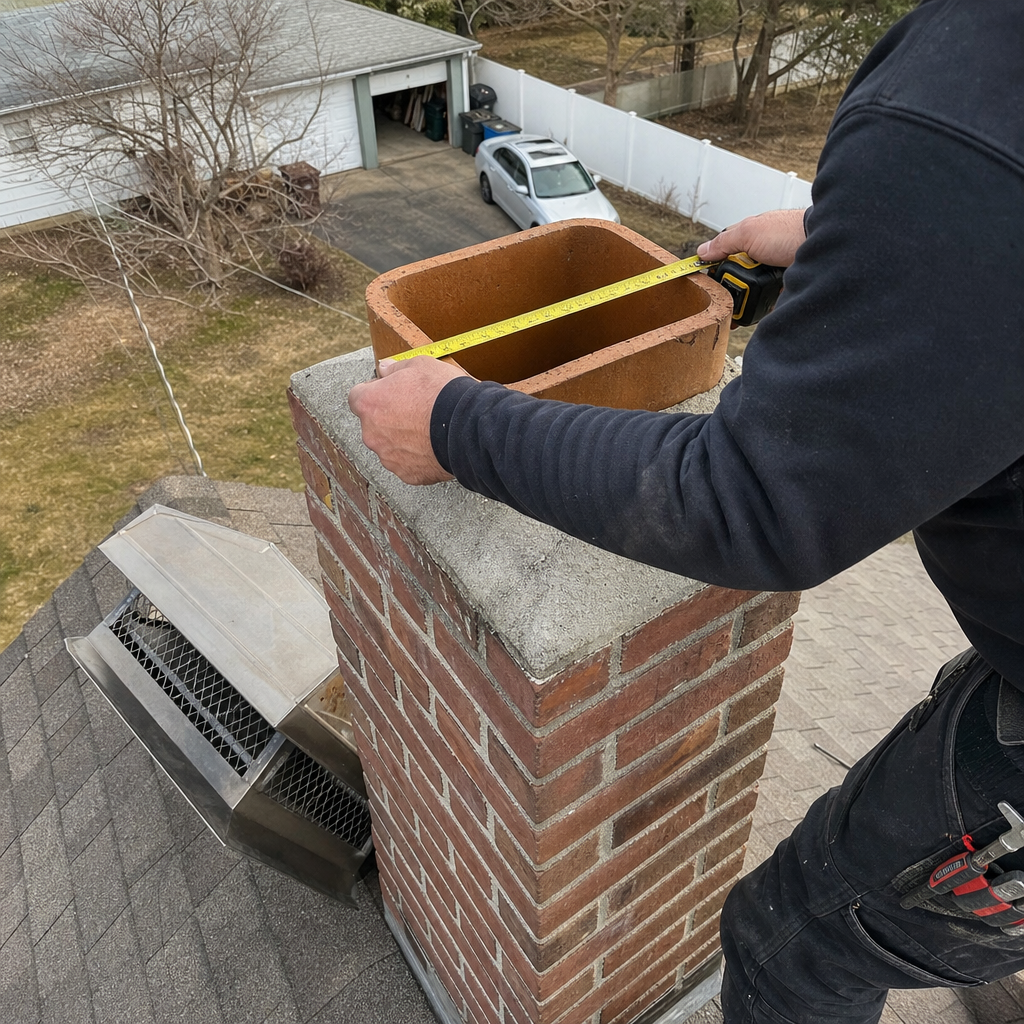
- Measure flue dimensions precisely — inside and outside, since the cap mounts to the exterior but must not obstruct the interior flow.
- Check draft with a smoke pencil or draft gauge, depending on conditions, to establish baseline performance.
- Inspect crown, flue tile, and mortar joints for water entry points that would undermine the cap.
- Recommend cap type and material based on your specific flue configuration, location, and budget.
- Install with proper fasteners, sealant rated for chimney temperatures, and post-install draft verification.
Most installs take 1–2 hours. We carry common stainless single-flue and multi-flue sizes on the truck; custom or copper caps require ordering but usually arrive within a week.
FAQs
Affordable Chimney Cap & Crown in Connecticut, CT installation typically costs $150 to $700, with most homeowners paying between $250 and $500 for a properly fitted stainless steel cap installed by a specialist. Single-flue caps start around $150–$350, multi-flue caps run $300–$600, and top-mount damper caps range from $400–$700. Call (833) 719-7193 for a free, exact quote based on your specific flue — estimates are free.
Repairing a chimney cap is rarely worth the cost unless it’s a high-end custom unit — most galvanized or thin stainless caps cost more to repair properly than to replace. We typically see “repaired” caps fail again within a season because the rust or damage has compromised the metal structure. For standard caps, replacement with a quality stainless unit from Gelco or Famco is the more economical long-term choice.
Yes, we complete most standard single-flue and multi-flue cap installations same-day because we carry common stainless steel sizes and mounting hardware on our service truck. Custom caps, copper units, or jobs requiring crown repair first need a return visit, usually scheduled within a week. Call (833) 719-7193 to check same-day availability — we serve across Connecticut from our base.
Signs that your chimney cap is causing draft problems include smoke backing up into the room when you start a fire, difficulty getting the fire to draw even with a cold chimney primed, or worsening performance on windy days specifically. We’ve found that caps with screens that are too fine, lids that are too low, or caps mounted on multi-flue chimneys without proper spacing between flues are the most common culprits in Connecticut’s variable wind conditions. If you’re experiencing these symptoms, a cap inspection and possible replacement often solves the problem for less than the cost of a service call for a “chimney won’t draft” mystery.
Ready for a Cap That Actually Works With Your Fireplace?
Don’t guess on a part that protects your chimney from water, animals, and debris while either helping or hurting your draft. Anthony Perez, owner and lead technician at Premier Chimney Cleaning Connecticut, measures every flue personally and installs Best Chimney Cap & Crown in Connecticut, CT options from Gelco and Famco — the same product lines specified by chimney professionals, not hardware-store substitutes. With eight years specializing exclusively in chimney work and 800+ customer reviews averaging 4.7 stars, we’ve earned the call-backs we get when homeowners want it done right the first time. Call (833) 719-7193 today for your free estimate.
Written by Anthony Perez, Owner & Lead Technician at Premier Chimney Cleaning Connecticut, serving Connecticut, CT.
What Our Customers Say
"Level two inspection before we bought the house. The report was detailed enough to use as a negotiating point and he explained every photo in it."
— Brian Hayes"Drop cloths everywhere, HEPA vac, and not a speck of soot on the carpet. I'd been dreading the mess for nothing."
— Rosa Torres"Creosote buildup was worse than I realized. He measured it, showed me the glazing on the flue with the camera, and was honest that we were closer to a chimney fire than I wanted to hear."
— Christine Chen