
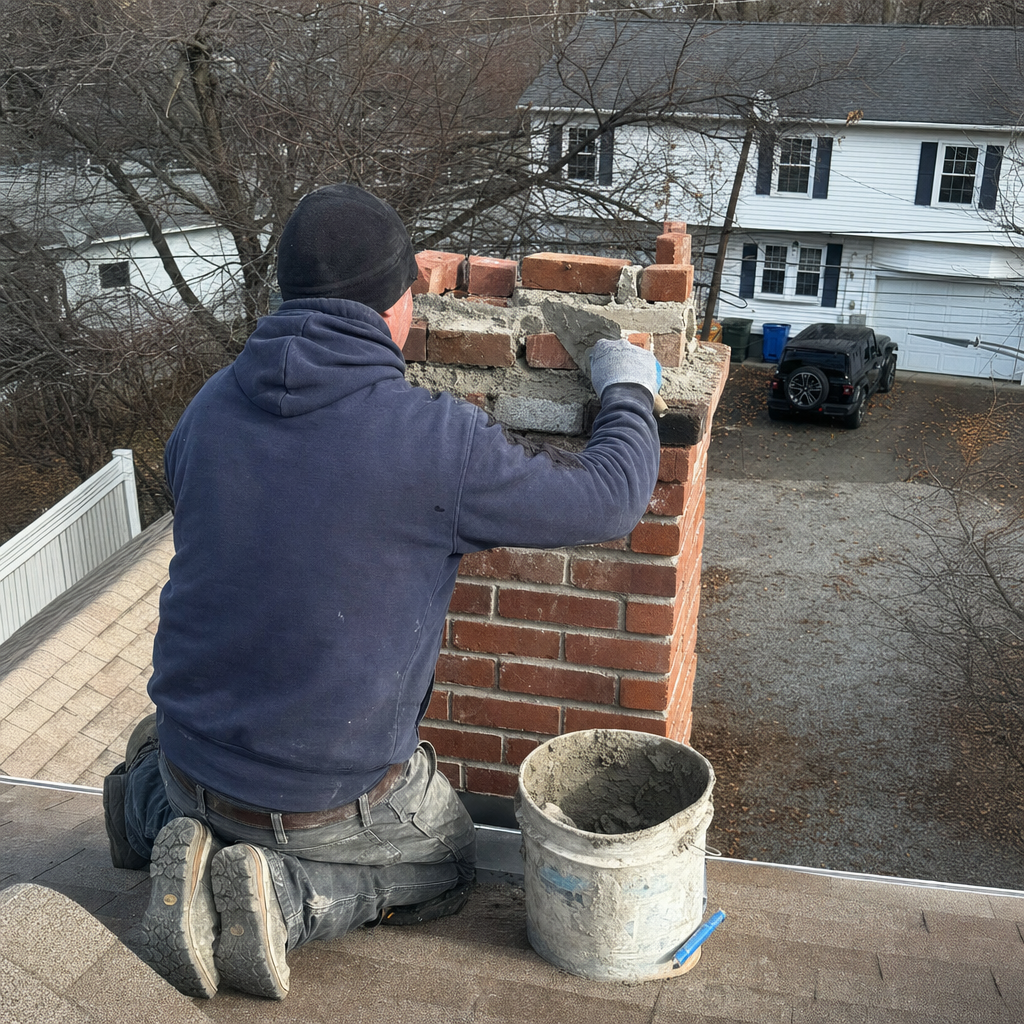
Chimney Flashing Repair in Connecticut: What Actually Fixes the Leak
Chimney Repair for flashing in Connecticut typically runs $450–$1,200 depending on whether we’re resealing counter-flashing joints, replacing step flashing, or installing a cricket saddle on a wide chimney. Most jobs we diagnose in the morning are wrapped by afternoon. If you’re seeing water stains on the ceiling near your fireplace, call (833) 719-7193 — we’ll get Anthony out to trace the actual source before water damages the framing.
Connecticut’s freeze-thaw cycles are brutal on masonry chimneys. We’ve worked on capes in West Hartford where the brick moved three-sixteenths of an inch between January and March — enough to shear through fresh caulk like it was never there. That’s the pattern we see again and again: homeowners hire a roofer to “seal the flashing,” the leak stops for eight months, then it comes back the first hard freeze. The chimney moved. The caulk didn’t.
Why Flashing Fails on Connecticut Chimneys — And Why Caulk Isn’t the Fix
Here’s what most repair pages won’t tell you: brick chimneys expand and contract at a completely different rate than the wood roof deck they’re bolted to. In Connecticut, that differential gets exaggerated. Our winters drop below zero, our summers hit ninety with humidity that swells roof sheathing. The chimney itself — dense masonry mass — heats and cools slowly. The roof deck breathes daily. Something has to give, and it’s almost always the seal between them.
We’ve stood on roofs in New Haven’s Fair Haven neighborhood, where Anthony grew up, and pointed to chimneys that had been “repaired” three times by three different roofers. Each time, someone ran a bead of polyurethane or roofing cement along the metal-to-brick joint. Each time, the masonry shifted, the caulk cracked, and the bedroom ceiling below got another brown stain. The roofers weren’t incompetent — they were treating a chimney problem as a roofing problem.
The actual repair requires two layers of metal that move independently:
- Step flashing — L-shaped pieces woven into each shingle course, sealed to the roof deck
- Counter flashing — A separate metal cap embedded into the chimney mortar joints, overlapping the step flashing like a lid
This two-part system lets the chimney settle, heave, and twist through the seasons while the counter flashing maintains a sliding seal against the step flashing below. When we install this correctly using commercial-grade lead or aluminum from professional supply lines — not the peel-and-stick flashing tape you’ll find at hardware stores — the assembly tolerates real movement. Anthony’s seen chimneys shift a quarter-inch over a single heating season. Tape tears. Proper step flashing with counter flashing rides it out.
We use materials from lines like Olympia Chimney and Famco — the same specifications chimney professionals specify, not substitutes. When a Connecticut chimney moves, and it will, that material choice is the difference between a permanent fix and a callback.
The Cricket Problem: Why Wide Chimneys in Older Connecticut Homes Leak From Behind
There’s a second failure mode we diagnose constantly on pre-1980 homes across Connecticut, especially in neighborhoods like Hartford’s West End or the older sections of Bridgeport. Wide chimneys — more than thirty inches across — with no cricket or saddle behind them create a dead valley where debris, snow, and ice accumulate. Water pools. Freezes. Thaws. Eventually the hydrostatic pressure pushes moisture up and under the flashing from the rear, where no roofer working from the front can even see it.
We’ve had homeowners tell us their roofer “checked the flashing” three times while the plaster behind the chimney breast kept dissolving. The leak wasn’t coming through the front flashing at all. It was coming from behind, driven by ice dam pressure in that dead valley. Installing a properly flashed cricket — a peaked miniature roof behind the chimney that sheds water to either side — solves it permanently. But you have to recognize the pattern first, and that means understanding chimney geometry, not just roofing.
Anthony’s been on roofs where he shook his head before his boots even hit the shingles. Cricket missing, six inches of compressed leaf debris in the valley, counter flashing caulked instead of embedded, crown wash cracked to the flue liner. Three separate trades could point to “their” part and claim it looked fine. Nobody was seeing the system.
That’s the difference eight years of chimney-only focus makes. We don’t sweep gutters or replace siding. We look at how the chimney, the flashing, the crown, and the flue work as a single assembly — because in Connecticut’s climate, they fail as one.
How We Diagnose Flashing Leaks vs. Crown Leaks — They Look Identical Inside
Here’s a misdiagnosis that costs Connecticut homeowners thousands: water stains on the ceiling near the fireplace get blamed on flashing when the actual source is a cracked or improperly sloped chimney crown. The interior damage looks the same. The repair is completely different.
Anthony checks three things before touching the flashing:
- Crown condition — Is the concrete wash cracked, flat, or sloped away from the flue? Water pooling on the crown migrates through hairline cracks and runs down the interior chimney walls, exiting at the ceiling line.
- Mortar joint integrity — Are the bed joints between courses eroded or receded? Wind-driven rain enters porous brick and mortar, then finds the path of least resistance — often the interior wall cavity.
- Flashing embedment — Is the counter flashing actually cut into the mortar joint with a reglet, or just surface-mounted with sealant? Surface mounting fails predictably; reglet embedding lasts decades.
We’ve saved homeowners in Fairfield County from unnecessary flashing replacement by pointing to a $400 crown repair instead. We’ve also found the opposite — perfect crowns with counter flashing that was never embedded at all, just pressed against the brick and caulked. The roofer who installed it probably didn’t know the difference. Anthony does, because it’s all he does.
Our Chimney Repair in Connecticut page covers crown work, tuckpointing, and full rebuilds if the damage has progressed. But for flashing specifically, the diagnostic discipline is the same: trace the water path before prescribing the fix.
Chimney Flashing Repair Costs in Connecticut
How Much Does Chimney Repair Cost? (2026 Price Guide) — Connecticut, CT depends on what we find, how accessible the chimney is, and whether we’re correcting a previous repair or starting fresh. Below are the ranges we quote for typical Connecticut homes — cape cods, colonials, and raised ranches from the 1950s through 1990s. Steep pitches, slate roofs, or multi-story work runs higher.
| Repair Type | Typical Range |
|---|---|
| Counter-flashing reseal / spot repair | $450 – $650 |
| Step flashing + counter flashing replacement (standard chimney) | $800 – $1,100 |
| Wide chimney with cricket installation | $1,000 – $1,800 |
| Chimney rebuild with new flashing integration | $2,500 – $5,500 |
We don’t quote over the phone for flashing work — the pitch, the existing flashing embedment method, and the crown condition all change the scope. Estimates are free, and Anthony brings a camera so you see what he’s seeing.
Should You Call a Roofer or a Chimney Specialist for a Flashing Leak?
This is the question we hear most, and Anthony’s answer is direct: if your chimney is masonry and older than twenty years, call a chimney specialist first. Here’s why.
Roofers are trained to seal roof penetrations. They excel at it. But a masonry chimney isn’t a vent pipe or a skylight — it’s a structural element that moves, settles, and deteriorates on its own timeline. A roofer sees the interface between roof and chimney. We see the chimney itself: the crown, the mortar, the liner, the internal structure that’s causing or contributing to the movement that’s tearing your flashing apart.
We’ve been called in after roofers replaced flashing twice on the same 1960s chimney in Meriden. The brick was spalling, the crown was dished and holding water, and the chimney was listing slightly off-plumb. No flashing in the world stays sealed on a structure that’s slowly tilting. We rebuilt the top four feet, installed a proper crown with positive slope, and only then set new lead counter flashing into reglet joints. That was four years ago. No callbacks.
I’d rather give you the straight answer on the roof than a comfortable one at the bottom of the ladder. Sometimes the flashing is fine and the chimney is the problem. Sometimes both need attention. You won’t know until someone who understands the whole system looks at it honestly.
What Premier’s Flashing Repair Includes — And What We Won’t Do
When we repair flashing, we don’t caulk and pray. Our standard includes:
- Removal of existing counter flashing and inspection of step flashing condition
- Cutting new reglet joints into sound mortar beds (not surface-mounting)
- Installation of commercial-grade lead or aluminum counter flashing, formed on-site to the chimney profile
- Integration with step flashing that extends minimum eight inches up the chimney wall
- Crown inspection and documented recommendation — we won’t ignore a crown that’s actively feeding water into the system
- Photo documentation of before, during, and after for your records
What we won’t do: apply peel-and-stick flashing tape and call it repaired. We’ve torn too much of that off Connecticut chimneys, brittle and cracked after two winters, to ever install it ourselves. We also won’t replace flashing on a chimney with significant structural lean or severe mortar deterioration without addressing the underlying issue first. It’s not about upselling — it’s about not taking your money twice for the same problem.
Our materials come from professional supply houses, not retail channels. When we specify HeatShield products for crown resurfacing in conjunction with flashing work, or Gelco components for cap and screen integration, it’s because those are the specifications Anthony’s seen hold up in Connecticut’s climate over his eight years in the field. Not because a distributor offered a spiff.
FAQs
Most affordable chimney repair in Connecticut, CT jobs for flashing fall between $450 and $1,200, with simple resealing at the lower end and full step flashing plus counter flashing replacement on a wide chimney at the higher end. Cricket installation for older homes without one typically adds $400–$600. Call (833) 719-7193 for a free, exact quote — Anthony inspects every job personally before pricing.
Recurring leaks almost always mean the repair addressed symptoms, not the cause: either caulk was used instead of proper metal counter flashing, the chimney itself is moving or deteriorating, or water is entering from behind a wide chimney with no cricket. We’ve re-repaired dozens of Connecticut chimneys where roofers recaulked the same joint three times while the actual problem was crown failure or missing rear drainage. A chimney specialist evaluates the whole system, not just the seal.
If your chimney is masonry and more than twenty years old, start by searching Chimney Repair Near Me in Connecticut, CT for a specialist. Roofers excel at sealing roof penetrations, but masonry chimneys move, settle, and deteriorate independently of the roof. The leak pattern from a cracked crown, eroded mortar, or structural shift looks identical to flashing failure from inside the house. We’ve saved homeowners from unnecessary flashing replacement by diagnosing crown leaks that roofers missed. Call (833) 719-7193 and we’ll trace the actual water path.
We perform flashing repair year-round in Connecticut, but January and February work has constraints: mortar reglets can’t be cut reliably when temperatures stay below freezing, and some sealants won’t cure properly. For urgent winter leaks, we can install temporary weatherproofing to stop interior damage, then complete the permanent repair in a warming trend. Waiting until spring risks ice dam pressure compounding the leak — if you’re seeing active water entry, call us now for interim protection.
Get the Actual Diagnosis — Not Another Band-Aid
Water stains don’t lie, but they don’t tell the whole truth either. The source of your chimney leak might be the flashing, the crown, the mortar, or a combination that only shows up to someone who evaluates chimneys full-time. Anthony Perez has spent eight years doing exactly that across Connecticut — he’s the one on your roof, not a subcontractor we hired last week.
We’ve earned our 800+ reviews at a 4.7-star average by telling homeowners exactly what we found, exactly what it costs, and exactly why it matters. No padding, no phantom repairs, no comfortable answers that fail next winter.
Call (833) 719-7193 today for a free estimate. We’ll get you scheduled, get Anthony on your roof with a camera, and get you the straight answer on what’s actually leaking.
Written by Anthony Perez, Owner & Lead Technician at Premier Chimney Cleaning Connecticut, serving Connecticut, CT.
What Our Customers Say
"Swept it, capped it, and installed a proper damper. The downdraft smell in the summer that we'd lived with for years is gone."
— Cole Ziegler"Cap keeps the birds out now, which after two springs of scratching noises is worth every penny."
— Oscar Garcia"Second time using them. Same guy, same good work."
— Keisha Mosley