
Chimney Cleaning Cost in Connecticut: What You’ll Actually Pay Based on What’s Burning in Your Fireplace
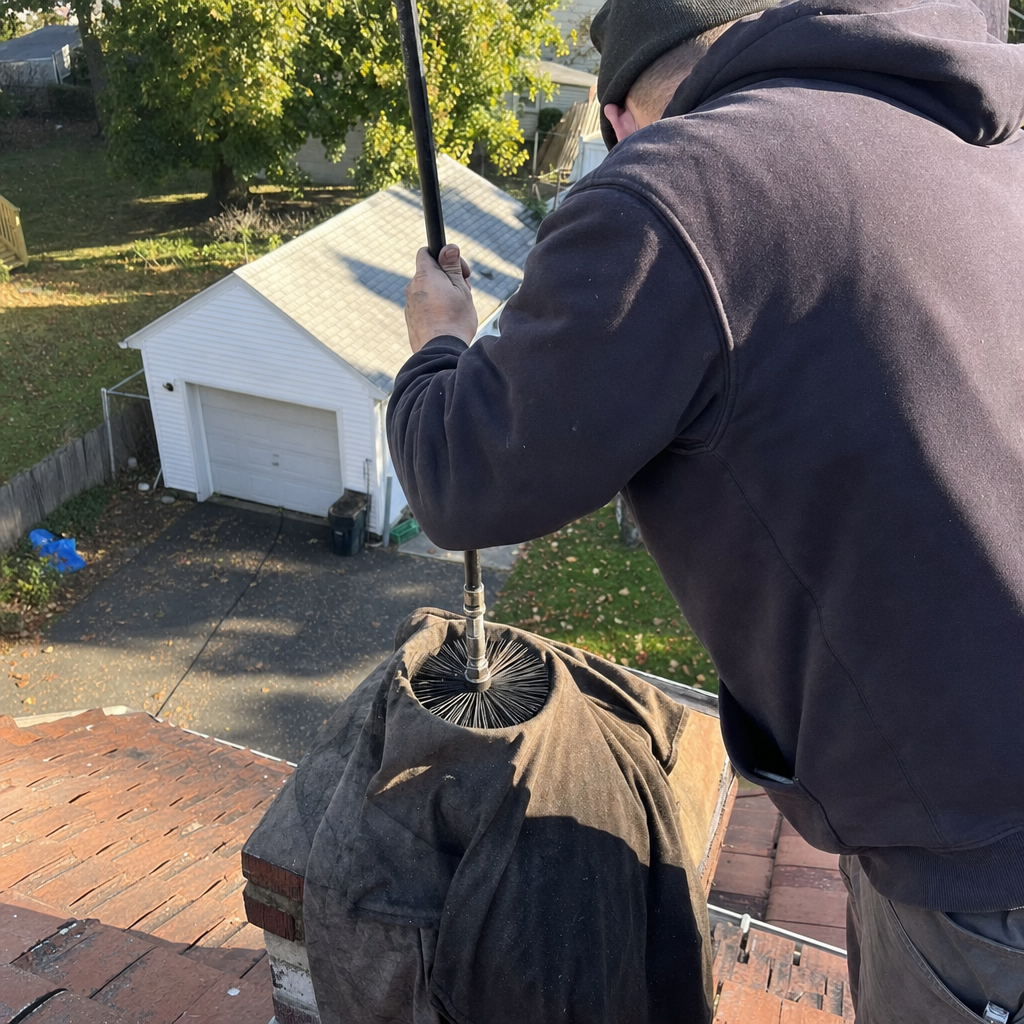
A routine chimney cleaning in Connecticut typically runs $189 to $325 for a standard Level 1 sweep on a wood-burning fireplace or insert in good condition. Gas fireplace cleaning usually falls between $149 and $225. If you’re burning cord wood in an older system with heavy creosote buildup, or you need a Level 2 inspection following a chimney fire, event, or appliance change, expect $350 to $550. Call (833) 719-7193 for an exact quote on your specific setup — estimates are free, and Anthony Perez, our owner and lead technician, personally evaluates every job.
Here’s what most cost pages won’t tell you: the “chimney cleaning cost” you see advertised in Connecticut rarely accounts for what you’re actually burning, how old your liner is, or whether the state’s brutal heating season has pushed your flue past routine maintenance into something that needs real attention. We’ve been on roofs in Hartford County where the homeowner expected a $199 sweep and we found Stage 3 glazed creosote coating a 1970s clay tile liner that hadn’t been opened in a decade. That’s not a bait-and-switch — it’s what happens when a generic price meets a specific chimney.
Why Wood-Burning Systems in Connecticut Cost More to Clean Than the National Average
Connecticut’s heating season runs roughly October through April, and plenty of households we’re in — especially through Litchfield County, the Quiet Corner, and up toward the Massachusetts line — burn three to five cords of hardwood per winter. That volume matters because creosote doesn’t accumulate linearly. It stages.
The National Fire Protection Association (NFPA 211) recognizes three stages of creosote buildup, and each one changes what we bring up the ladder:
- Stage 1 (Sooty, brushable): Light, powdery deposit. A standard rotary sweep with poly brushes handles this in about 45–60 minutes. This is your routine annual cleaning.
- Stage 2 (Crunchy, flaky): Hardened tar-like flakes that need more aggressive tools — chain whips, harder bristle configurations, sometimes chemical pretreatment. Adds 30–45 minutes and more equipment wear.
- Stage 3 (Glazed, hardened): Shiny, rock-hard creosote that can only be removed with specialized chemical treatments, mechanical grinding, or in severe cases, replacement of the liner itself. This is where “chimney cleaning” becomes “chimney restoration.”
We’ve found Stage 3 creosote in chimneys from Bristol to Manchester where the homeowner burned “only on weekends” but never realized that burning unseasoned wood, restricting airflow, or running the insert on its lowest setting for overnight burns accelerates staging dramatically. Anthony’s seen it enough that he can usually guess the burning habits before he opens the cleanout door — the pattern recognition that comes from eight years of looking at nothing but flue systems.
The other Connecticut factor: older housing stock. We’ve got pre-war colonials in New Haven, 1970s raised ranches in Waterbury, and century-old farmhouses in the northwest hills that still have unlined brick chimneys or clay tile liners installed decades ago. Those liners crack, shift, and create ledges where creosote accumulates in ways a modern stainless steel liner doesn’t. Cleaning an 8″ by 8″ clay tile flue with offset joints takes longer, requires more manual work, and sometimes reveals damage that changes the scope entirely.
Gas Fireplaces: Cheaper to Clean, But “Never Needs Service” Is a Dangerous Myth
Gas log sets and direct-vent fireplaces produce different residue — carbon, moisture, and in some cases sulfur compounds that eat at the firebox refractory. The cleaning itself is faster: we’re not dealing with creosote, and the venting is typically straighter and more predictable. That’s why gas fireplace cleaning runs lower, typically $149–$225.
But the “gas fireplaces are maintenance-free” line we hear from homeowners in Fairfield County suburbs? That’s how you get a blocked vent terminal, a cracked heat exchanger, or carbon monoxide backing into the living space. We still run our camera on gas systems. We still check draft and spillage. And we still find bird nests, deteriorated termination caps, and moisture damage that the “quick gas sweep” guys skip because they’re in and out in twenty minutes.
We use Famco and Copperfield termination components when replacements are needed — the same brands specified in professional chimney supply catalogs, not the universal-fit hardware store caps that rust through in three Connecticut winters.
Level 1 vs. Level 2 Cleaning: The NFPA Distinction That Explains Your Price Jump
Generic cost pages throw around “basic cleaning” and “deep cleaning” like they’re mattress firmness levels. We use NFPA 211 terminology because it actually means something — and because your homeowner’s insurance may care which one you had done.
| Service Level | Typical Cost in Connecticut | What It Covers | When You Need It |
|---|---|---|---|
| Level 1 Cleaning & Inspection | $189 – $325 | Visual inspection of accessible portions; standard rotary sweep; debris removal; basic condition report | Annual maintenance; no changes to system; no known problems |
| Gas Fireplace Service & Clean | $149 – $225 | Burner inspection; venting check; carbon/soot removal; safety controls test; terminal inspection | Annual maintenance on gas logs, inserts, or direct-vent units |
| Level 2 Cleaning & Inspection | $350 – $550 | Video scan of full flue interior; accessible portions of exterior; attic and basement connections; detailed written report with documentation | After chimney fire, lightning strike, or seismic event; before property sale; after appliance change; if Level 1 reveals suspected hazard |
| Heavy Creosote Removal (Stage 3) | $400 – $750+ | Chemical treatment cycle(s); mechanical removal; possible liner evaluation; follow-up inspection | Glazed creosote confirmed by camera inspection; neglected maintenance; improper burning practices |
The Level 2 is where our DuraFlex camera system earns its keep. We’re not guessing at flue condition — we’re recording it, measuring it, and showing you exactly what we found. That documentation matters if you’re selling a home in Connecticut’s competitive market, filing an insurance claim after a chimney fire in Norwich or New London, or trying to understand whether that “small crack” is actually a liner failure that requires full replacement.
What Drives the High End of Chimney Cleaning Cost in Connecticut
We’ve hit the upper range of our pricing — and occasionally exceeded it — for specific scenarios that aren’t failures of the chimney, just realities of the property:
Steep roof access. A three-story colonial in West Hartford with a 12/12 pitch and slate shingles requires different rigging than a ranch in Meriden. We’re insured for the work, but the time and safety setup affects scheduling and labor.
Blocked or deteriorated cleanout doors. Some older Connecticut homes have cleanout doors rusted shut, buried in finished basements, or never installed at all. Getting debris out of a flue with no lower access point means working from the top exclusively, which is slower and messier.
Animal extraction. Raccoons, squirrels, and chimney swifts love uncapped flues. We’ve removed nests in June that were packed from smoke chamber to flue top, and that work is biological hazard cleanup, not standard sweeping.
Prefabricated fireplace systems with internal baffles. Many factory-built fireplaces installed in 1980s–2000s Connecticut construction have baffle assemblies that must be removed and reinstalled precisely for proper cleaning. Miss the reassembly, and the next fire overfires the box and voids the unit’s listing.
Common Local Scenarios: What Connecticut Homeowners Actually Call Us For
These aren’t hypotheticals — they’re the calls that come in regularly, and they shape what chimney cleaning cost means in practice:
The “We Just Bought the House” Call (Everywhere, but especially older suburbs)
Homeowner in Hamden, Wallingford, or Stratford closes on a 1960s–1980s property in October, lights the first fire by Thanksgiving, and smells something acrid. We arrive to find a flue that hasn’t been swept in five to fifteen years, sometimes with a partially collapsed clay liner, sometimes with an old wood stove installation that was never properly connected. The “cleaning” becomes a Level 2 inspection, a heavy deposit removal, and a repair estimate. The homeowner’s initial $200 mental budget becomes $600–$1,200 of necessary work. We’d rather give you the straight answer on the roof than a comfortable one at the bottom of the ladder.
The “It Worked Fine Last Year” Wood Burner (Rural and semi-rural Connecticut)
Customer in Columbia, Lebanon, or the wood-burning pockets of Tolland County burned three cords last winter on a 1990s insert with a stainless liner. They skipped last year’s sweep because “it was drawing fine.” We open it up and find the liner has detached at the top, creosote has packed the gap, and they’re one hot fire away from a flue fire that would have required the fire department. The cleaning is straightforward; the liner reconnection and top plate replacement add cost, but prevent a catastrophe.
The Gas Log Conversion (Suburban Fairfield and New Haven counties)
Homeowner switches from wood to gas for convenience, assumes the chimney “doesn’t need anything anymore.” Two years later, moisture damage has deteriorated the terracotta firebox panels, or the original clay liner is sweating condensation that degrades the masonry. Gas produces water vapor — about a gallon per hour of operation — and that water has to go somewhere. We clean the system, camera the flue, and often recommend a HeatShield cerfractory seal or a new stainless liner sized properly for the gas appliance’s lower temperature, higher moisture output.
The Pre-Listing Inspection Surprise (Active market towns)
Seller in Guilford, Madison, or Simsbury schedules what they think is a routine sweep before the home inspector arrives. Our Level 2 scan finds a cracked crown, spalled brick, or deteriorated mortar joints that the buyer’s inspector would have flagged anyway. Better to find it with us, price it accurately, and disclose or repair on your terms than to watch a sale renegotiate in the eleventh hour.
Why Our Pricing Reflects What We Bring to the Job
We’re not the cheapest chimney sweep in Connecticut, and we’re not trying to be. Our pricing reflects:
- Owner-operated accountability. Anthony Perez leads every job. You’re not getting a seasonal hire who learned the basics in a weekend certification course and won’t be in the trade next year. You’re getting someone who has handled hundreds of flue systems across Connecticut’s full range of construction eras and burning practices.
- Professional-grade equipment. Our rotary sweeping system isn’t a brush set from a supply catalog. The camera we run is the same DuraFlex inspection gear we use to document liner installations. The repair materials we specify — HeatShield, Gelco, Olympia Chimney — are what industry professionals use, not what fits in a pickup truck.
- Full-service capability. When we find a cracked crown, a failed liner, or spalling brick, we don’t hand you a referral card. We handle the repair, the rebuild, or the liner replacement ourselves. From annual sweep to full rebuild — it’s the same crew, the same accountability, the same phone number.
Eight years, one specialty. That’s the difference between someone who sees a dirty flue and someone who sees why it’s dirty, what that means for your safety, and whether the fix is a sweep, a repair, or a conversation about how you’re burning.
FAQs
A standard Level 1 chimney cleaning in Connecticut costs between $189 and $325 for wood-burning systems, and $149 to $225 for gas fireplaces. Heavy creosote removal or Level 2 inspections run $350 to $550 or more depending on what we find. Call (833) 719-7193 for a free estimate based on your specific fireplace, fuel type, and flue condition.
Yes — gas fireplace cleaning typically costs $149 to $225 compared to $189 to $325 for wood-burning systems, because gas produces carbon and moisture residue rather than creosote, and the venting is generally straighter and more accessible. But gas systems still require annual inspection and cleaning to prevent vent blockages, moisture damage, and carbon monoxide hazards. Call (833) 719-7193 to schedule either service.
Level 1 is a standard annual cleaning with visual inspection of accessible portions, costing $189 to $325. Level 2 adds a full video scan of the flue interior, accessible exterior inspection, and detailed written documentation, costing $350 to $550 — it’s required after chimney fires, lightning strikes, appliance changes, or before real estate transactions. We use NFPA 211 terminology because your insurance and home sale may depend on which level was performed. Call (833) 719-7193 to discuss which level your situation requires.
A $99 chimney “sweep” is typically a loss-leader appointment designed to upsell repairs — often unnecessary ones — or it’s a quick brush pass with no inspection, no camera, and no documentation. We’ve been called in after these jobs to find missed hazards, incomplete cleaning, and in one case in Bridgeport, a flue fire that occurred two weeks after a “clean” chimney. Our pricing covers actual time, professional equipment, and Anthony’s direct expertise. Call (833) 719-7193 for an upfront quote with no hidden upsells.
Get an Exact Quote on Your Chimney Cleaning
Every chimney in Connecticut has burned differently, aged differently, and needs to be evaluated on its own terms. Whether you’re in a 1920s New Haven colonial with original clay tile, a 1980s Glastonbury ranch with a factory-built fireplace, or a converted barn in Litchfield County with a wood stove and a story to tell, we’ll tell you exactly what your cleaning will cost before we start — and why. Call (833) 719-7193 for a free estimate, or schedule your Chimney Cleaning & Sweep directly. Anthony Perez, our owner and lead technician, personally handles every evaluation.
Written by Anthony Perez, Owner & Lead Technician at Premier Chimney Cleaning Connecticut, serving Connecticut, CT.
What Our Customers Say
"Creosote buildup was worse than I realized. He measured it, showed me the glazing on the flue with the camera, and was honest that we were closer to a chimney fire than I wanted to hear."
— Christine Chen"Liner was cracked in two places. He walked me through the repair options honestly, including the one that was cheaper for him and better for me."
— Amanda Delaney"Fireplace had never drawn properly since we moved in. He found the damper was only opening halfway due to a bent linkage and fixed it in ten minutes."
— Reggie Ellison