
Chimney Repair in Pleasantville, NY
Chimney repair in Pleasantville typically costs between $450 and $3,800 depending on whether you need mortar repointing, liner replacement, or partial rebuilding, and most jobs are completed within one to three days. We’re based in Connecticut and regularly make the run down to Pleasantville, usually arriving the same day you call or by the next morning. If you’re living in one of the village’s older homes near the Metro-North station, along Washington Avenue, or up in the hills off Bedford Road, your chimney was built for coal heat and converted later — that history changes what “repair” means here. Call us at (833) 719-7193.
Why Pleasantville Homes Are Different
Pleasantville is a compact railroad-suburb village developed primarily between 1890 and 1930, meaning a high concentration of its homes have original Victorian and Colonial Revival masonry chimneys that were built for coal-burning systems and later converted to oil or gas heat. That leaves oversized, deteriorating clay tile flue liners that no longer properly match modern appliance venting, making liner assessment and relining a central issue on nearly every cleaning job here rather than an occasional upsell.
The majority of Pleasantville’s residential stock consists of late-19th- to early-20th-century Victorians, Colonials, and Craftsman bungalows clustered within walking distance of the Metro-North Harlem Line station, many with two or more original masonry chimneys featuring terra-cotta flue tiles that are now 100-plus years old and prone to cracking, spalling, and mortar joint failure. Westchester County’s pronounced freeze-thaw cycle — with temperatures oscillating above and below freezing dozens of times each winter — is especially hard on the aged brick-and-mortar chimneys common here, accelerating spalling and liner cracking. The village’s topography, nestled among hills, also produces variable wind patterns that contribute to downdraft and draft-reversal complaints that technicians must diagnose alongside standard creosote buildup.
In the older blocks near the village center, technicians routinely find chimneys where a coal-era 12×12 or larger flue now vents a modern gas furnace — the mismatch causes chronic condensation and acidic flue gas corrosion of the original clay liner, so a cleaning call almost always surfaces a relining conversation that wouldn’t come up as predictably in the newer mid-century subdivisions of neighboring Hawthorne or Thornwood.
Chimney Repair in Pleasantville
Chimney repair in Pleasantville isn’t a generic service because the village’s housing stock isn’t generic. We’re working on 100-year-old masonry that was built for a different fuel, in a climate that punishes aged brick, on hills that create wind problems you won’t find in flatter terrain. Anthony Perez leads every job personally, and after eight years specializing exclusively in chimney work, he’s developed a diagnostic instinct for the failure patterns that repeat in Pleasantville’s pre-1930 homes. Our Chimney Repair hub covers our full scope, but here’s what we actually do in this village.
Chimney Rebuilding
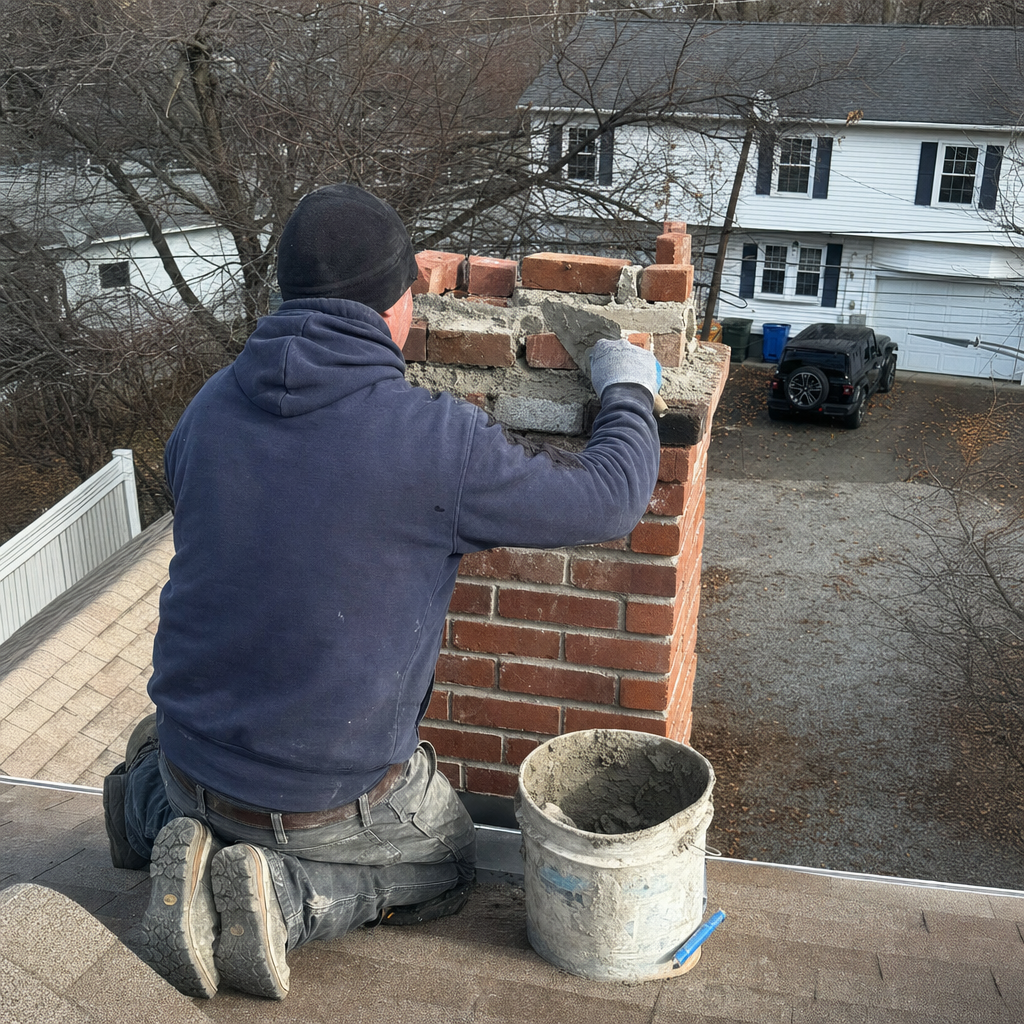
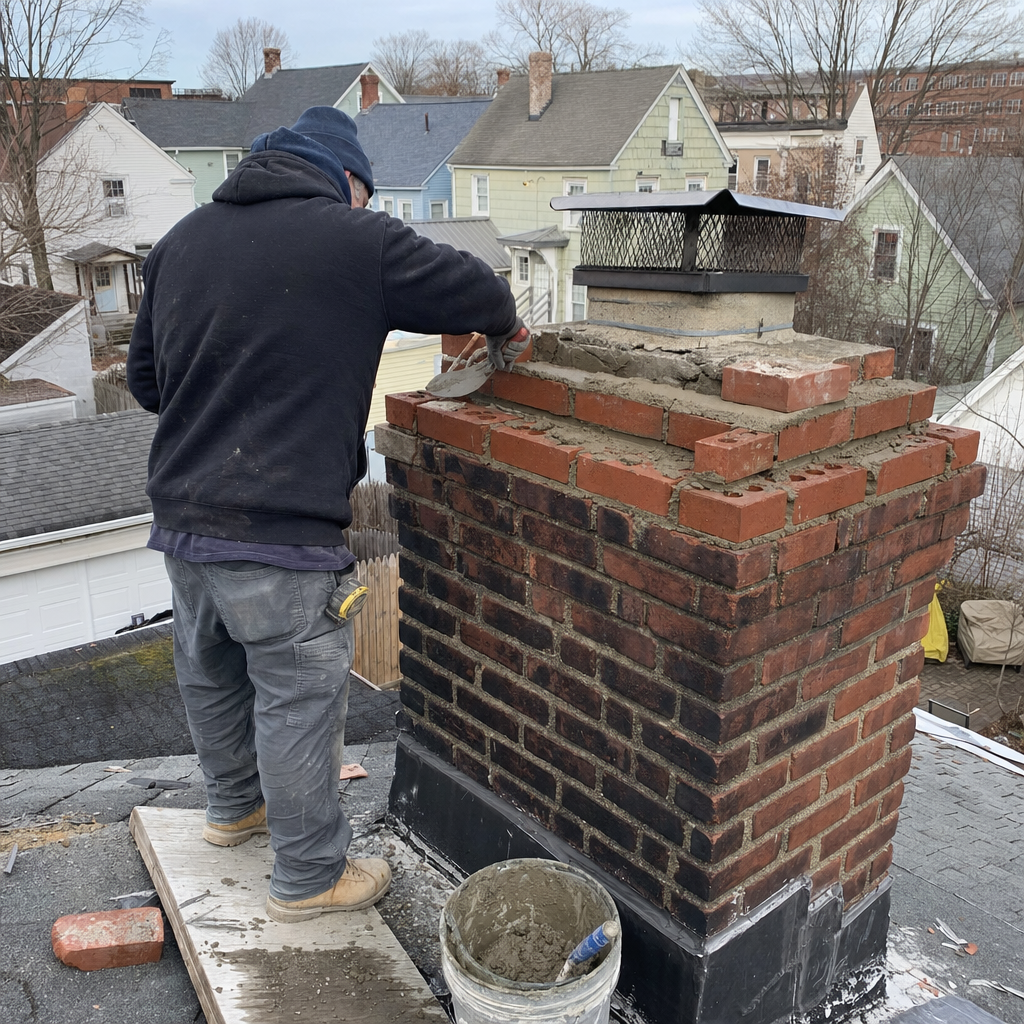
Some Pleasantville chimneys have simply reached the end of their service life. In the village center and along the older blocks near the railroad station, we regularly find structures where the original mortar has turned to sand and the brick faces are spalling off in layers. When more than 25–30% of the masonry is compromised, rebuilding sections of the stack becomes more cost-effective than chasing individual cracks. Partial chimney rebuilds in Pleasantville typically run $2,800–$5,500. We rebuild with matching brick where possible and always reassess the flue liner system before closing up — because in Pleasantville, there’s almost always a liner conversation hiding inside the masonry problem.
Chimney Waterproofing
Westchester’s freeze-thaw cycle is brutal on aged masonry, and Pleasantville’s hills expose chimneys to variable wind-driven rain that accelerates water penetration. We apply professional-grade breathable sealers — not the hardware-store stuff that traps moisture inside — specifically formulated for the porous brick common in pre-1930 construction. Waterproofing a typical Pleasantville chimney runs $800–$1,400 and can add decades of life to sound masonry that’s simply suffering from water intrusion. We always pair this with crown repair or replacement, since a cracked crown is the primary entry point we see on Washington Avenue and the surrounding historic blocks.
Tuckpointing & Mortar Repointing
Repointing is the surgical option: grind out deteriorated mortar to proper depth and pack new, color-matched mortar into the joints. In Pleasantville’s Victorian and Colonial Revival homes, this preserves the original aesthetic while restoring structural integrity. Typical repointing for a standard chimney runs $1,200–$2,800 here, depending on accessibility and how many courses need attention. We use lime-based mortars compatible with historic masonry — not Portland cement, which is too rigid and accelerates the very cracking you’re trying to fix.
Spalling Brick Repair
Spalling — where the brick face flakes or pops off — is everywhere in Pleasantville after February thaws. It’s not cosmetic. Once the hard outer face is gone, the softer interior absorbs water faster, and the cycle accelerates. We replace individual spalled bricks with reclaimed or matching new units, then address the moisture source. Often that’s a failed crown, missing cap, or deteriorated flashing. Localized spalled brick replacement typically costs $450–$1,100 in Pleasantville. Patch-only approaches fail within two seasons here; we’ve learned to fix the cause, not just the symptom.
Flashing Repair
The intersection where your chimney meets the roof is a common leak point in Pleasantville’s older homes, many of which have seen multiple roof overlays that left flashing buried, bent, or improperly counterflashed. We remove compromised flashing, install new step and counterflashing integrated with your roofing, and seal with high-temperature compounds. Most flashing repairs in Pleasantville run $650–$1,200.
How much does chimney repair cost in Pleasantville?
Most chimney repairs in Pleasantville fall between $450 for localized brick replacement and $3,800 for stainless steel liner installation with associated masonry work. Repointing typically runs $1,200–$2,800, waterproofing $800–$1,400, and partial rebuilds $2,800–$5,500. Call (833) 719-7193 for an exact quote — estimates are free.
Should I repair or rebuild my chimney if the brickwork is spalling?
If less than 25% of the masonry is affected and the structural core is sound, targeted brick replacement and repointing is the right call — typically $1,200–$2,800 in Pleasantville. Once spalling exceeds 30% of the surface, or if multiple courses are involved, partial rebuilding becomes more economical than chasing an accelerating failure. Anthony Perez assesses every chimney personally and will show you the camera footage and photos so you can see what we see.
Chimney Cleaning & Sweep in Pleasantville
Chimney cleaning and sweep service in Pleasantville, NY typically costs $180–$450 depending on inspection level and flue condition, with most routine annual sweeps completed in under two hours. We’re usually on-site in Pleasantville within 24–48 hours of your call, sometimes same-day during the fall pre-heating rush. We know Pleasantville’s chimneys — the village’s concentration of 1890-to-1930 homes means we’re not dealing with standard construction. These are coal-era masonry systems with flue liners that are often cracked, oversized, or both. Our Chimney Cleaning & Sweep page details our full process, but here’s what matters locally.
Level 1 Inspection
A Level 1 inspection is the baseline for any Pleasantville home with an active fireplace or heating appliance venting through a chimney. We examine readily accessible portions of the appliance, chimney connection, and flue interior for obstructions, creosote buildup, and structural soundness. In Pleasantville’s older housing stock, even this “routine” inspection often flags issues: cracked clay tiles, deteriorated mortar joints, or evidence of past chimney fires hidden in the flue. Level 1 inspection with annual sweep runs $180–$260. We document everything with photos you can reference.
Level 2 Inspection
Level 2 inspections are where Pleasantville’s coal-era chimneys tell their real story. We use video scanning equipment to examine the entire flue interior, including areas hidden from standard visual inspection. This is non-negotiable for homes built between 1890 and 1930 — essentially the entire village center and surrounding blocks. The oversized clay flue liners originally designed for coal combustion create specific failure modes when repurposed for modern gas or oil systems: chronic condensation, acidic flue gas corrosion, and accelerated tile spalling. Level 2 inspection with video scan costs $320–$450. Our Level 2 inspection catches these before they become carbon monoxide hazards.
Creosote Removal
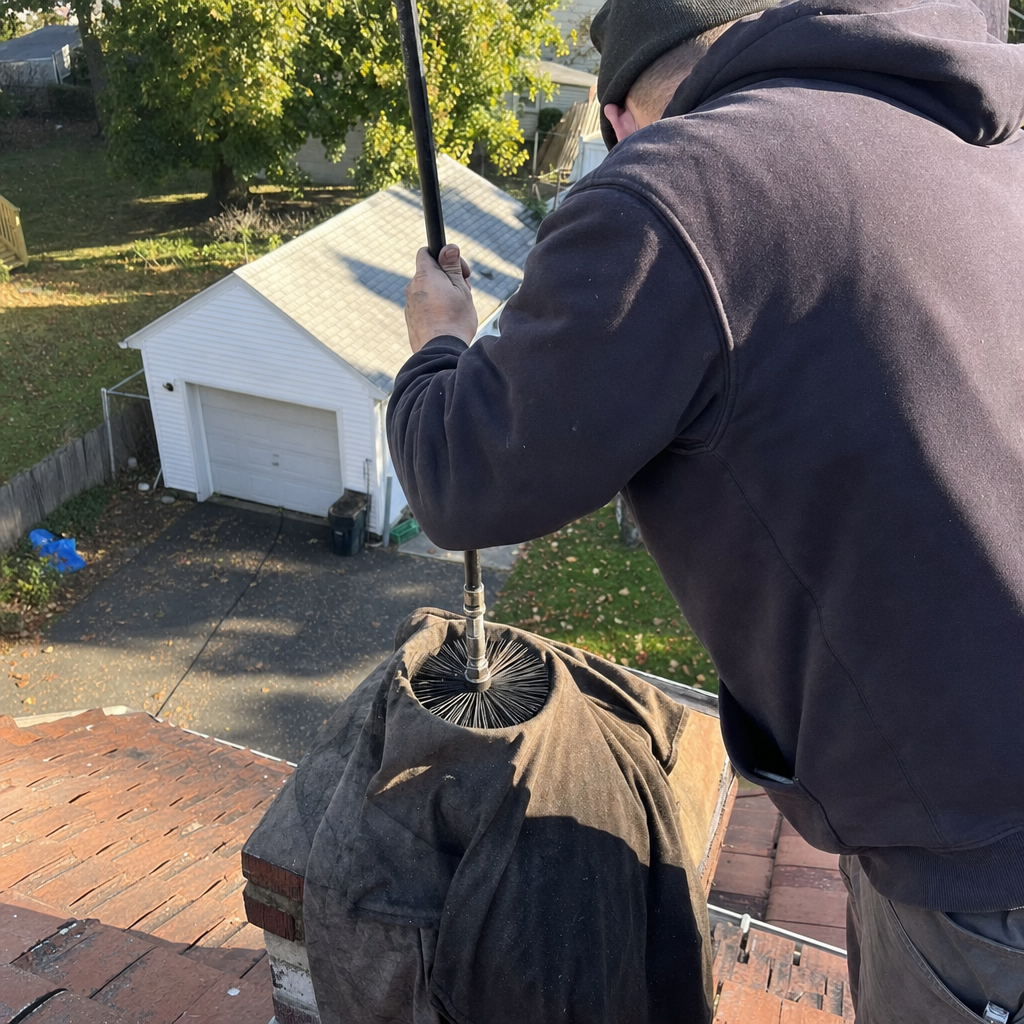
Creosote accumulation is the leading cause of chimney fires nationwide, and Pleasantville’s variable hillside winds don’t help. Downdraft conditions can cool flue gases prematurely, causing heavier creosote deposition than in areas with consistent draft. We use professional rotary cleaning systems and hand brushes sized to your specific flue dimensions — not one-size-fits-all hardware-store tools. For glazed creosote (Stage 3), which we encounter frequently in Pleasantville homes where homeowners burned unseasoned wood during supply shortages, we apply specialized chemical treatments before mechanical removal. Stage 1–2 creosote removal runs $200–$280; glazed Stage 3 removal is $350–$500. This isn’t optional maintenance; it’s fire prevention.
Why is a chimney liner assessment always needed during a cleaning in Pleasantville?
Because Pleasantville’s housing stock was built for coal, not modern appliances. The oversized clay flue liners common here — often 12×12 or larger — create chronic condensation and acidic corrosion when venting high-efficiency gas furnaces. We assess liner condition on every Pleasantville job, not as an upsell, but because the mismatch between original flue design and current appliance is nearly universal in this village. Call (833) 719-7193 to schedule — estimates are free.
Can you clean a chimney with a large coal-era flue that’s now used for gas?
Yes, we clean them routinely — but we won’t just brush and leave. The cleaning process itself reveals whether the oversized flue is creating dangerous conditions: excessive condensation, poor draft, or liner deterioration. In Pleasantville, this is standard, not exceptional. We clean, inspect, and then explain whether your flue system matches your appliance. If it doesn’t, we quote the reline. No surprises after the fact.
Fireplace Services in Pleasantville
Fireplace services in Pleasantville typically cost between $180 and $650 depending on whether you need a routine gas fireplace tune-up or firebox and damper repairs in an older masonry unit, and we can usually schedule within 24–48 hours throughout the 10570, 10571, and 10572 ZIP codes. If you’re on a Bedford Road Colonial Revival or one of the village’s classic Victorians near the Metro-North station, your chimney was likely built for coal heat and later converted — that history matters for every fireplace service we perform. Our Fireplace Services page covers the full range, but here’s what we do in Pleasantville.
Gas Fireplace Service
Gas fireplace service in Pleasantville runs $180–$320 for a standard tune-up and safety inspection, with repairs to valves, thermocouples, or burners adding $150–$400 depending on parts. Many Pleasantville homeowners converted from wood to gas without addressing the underlying flue mismatch — we check that your venting is actually sized for the appliance, not just “working.” On the gas conversions we’ve done near Manville Road, we’ve found original coal flues producing acidic condensate that corrodes the new gas insert’s venting within seasons. We fix the flue first, then the fireplace.
Wood Burning Fireplace
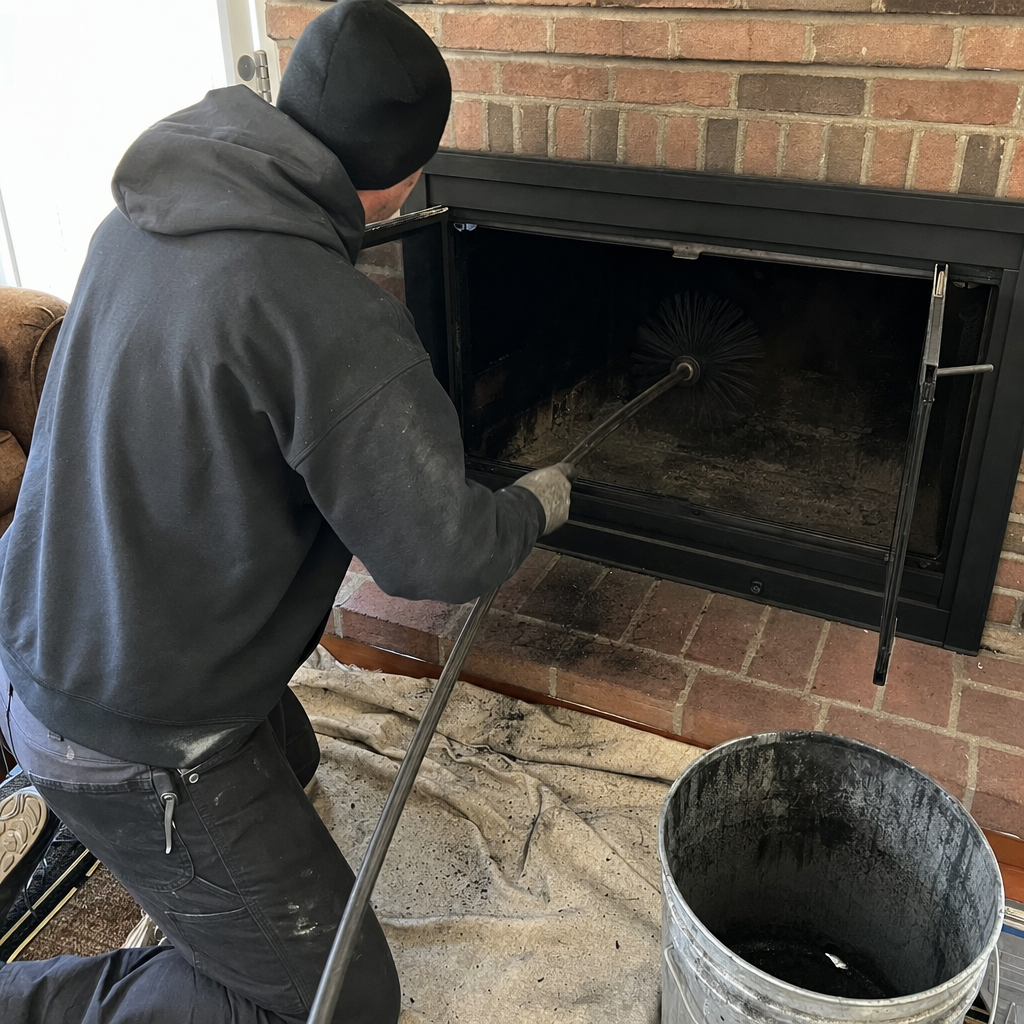
Wood-burning fireplace cleaning and inspection in Pleasantville costs $220–$280, with creosote-heavy systems or those needing firebox tuckpointing running higher. The village’s older homes often have fireplaces that haven’t seen regular use since the oil conversion decades ago — reopening them requires more than a sweep. We inspect for deteriorated smoke chambers, missing or damaged dampers, and the cracked terra-cotta liners that Westchester’s freeze-thaw cycles punish mercilessly. If you’re on one of the village’s hillside streets where wind-driven rain saturates the masonry, we’ll flag water damage that compromises safe wood burning.
Fireplace Insert Installation
Fireplace insert installation in Pleasantville ranges from $2,800–$4,500 for a complete system with proper liner connection, with high-efficiency models or complex retrofits toward the upper end. The critical issue here is liner compatibility: dropping an insert into a coal-era 12×12 flue without a properly sized stainless steel liner creates the same condensation and corrosion problems we see on furnace conversions. We size and install DuraFlex liners specifically matched to your insert’s BTU output and venting requirements, then seal the surround to prevent drafts into the room.
My Pleasantville Victorian has a chimney that was originally for coal. Can it safely vent my new gas furnace?
Not without modification. The 12×12 or larger flue built for coal is too oversized for modern gas appliances, causing acidic condensation that corrodes the clay liner and creates dangerous flue gas leaks. We install a properly sized DuraFlex stainless steel liner matched to your furnace’s output, which is the standard safe solution for Pleasantville’s converted chimneys. Call (833) 719-7193 — Anthony will inspect your specific flue and explain exactly what yours needs.
Can I convert my wood-burning fireplace to gas without a full reline?
Sometimes, but rarely in Pleasantville’s pre-1930 housing stock. If your chimney has a properly sized, intact clay liner in good condition, a direct-vent gas insert may work without relining. In practice, we almost never find that scenario in village center homes — the liners are cracked, oversized, or both. We evaluate every flue with a camera before recommending any conversion path, and we’ll show you the footage so you understand why.
What happens when you call
- 1
A real person answersNo phone trees — you reach a local pro.
- 2
You get an upfront price rangeHonest numbers before anyone is dispatched.
- 3
A background-checked tech heads outLicensed & insured, dispatched right away.
- 4
You approve before work beginsNothing starts until you say go.
Chimney Cap & Crown in Pleasantville
Chimney cap and crown repair in Pleasantville typically runs $650–$2,400 depending on whether you’re replacing a standard cap or rebuilding a deteriorated crown on an original masonry chimney, and most jobs we can schedule within 48 hours. If you’re seeing water stains on your ceiling near the chimney breast or finding bits of mortar in your fireplace, the crown underneath your cap has likely failed — and in Pleasantville’s 1890-to-1930 housing stock, that almost always means working around oversized, century-old flue configurations that stock caps don’t fit. Our Chimney Cap & Crown page has more detail, but here’s our Pleasantville approach.
Cap Installation
New cap installation in Pleasantville runs $380–$720 for standard galvanized or black steel models, $890–$1,400 for copper or custom-fabricated units sized for oversized flues. Most homes in the village center have 12×12 or larger clay flue openings from the coal-conversion era — a standard 8×13 cap won’t seat properly and creates a condensation trap. We measure the flue precisely, account for any crown deterioration, and install caps with proper overhang and screen height to handle the variable wind patterns that come with hillside terrain.
Crown Repair
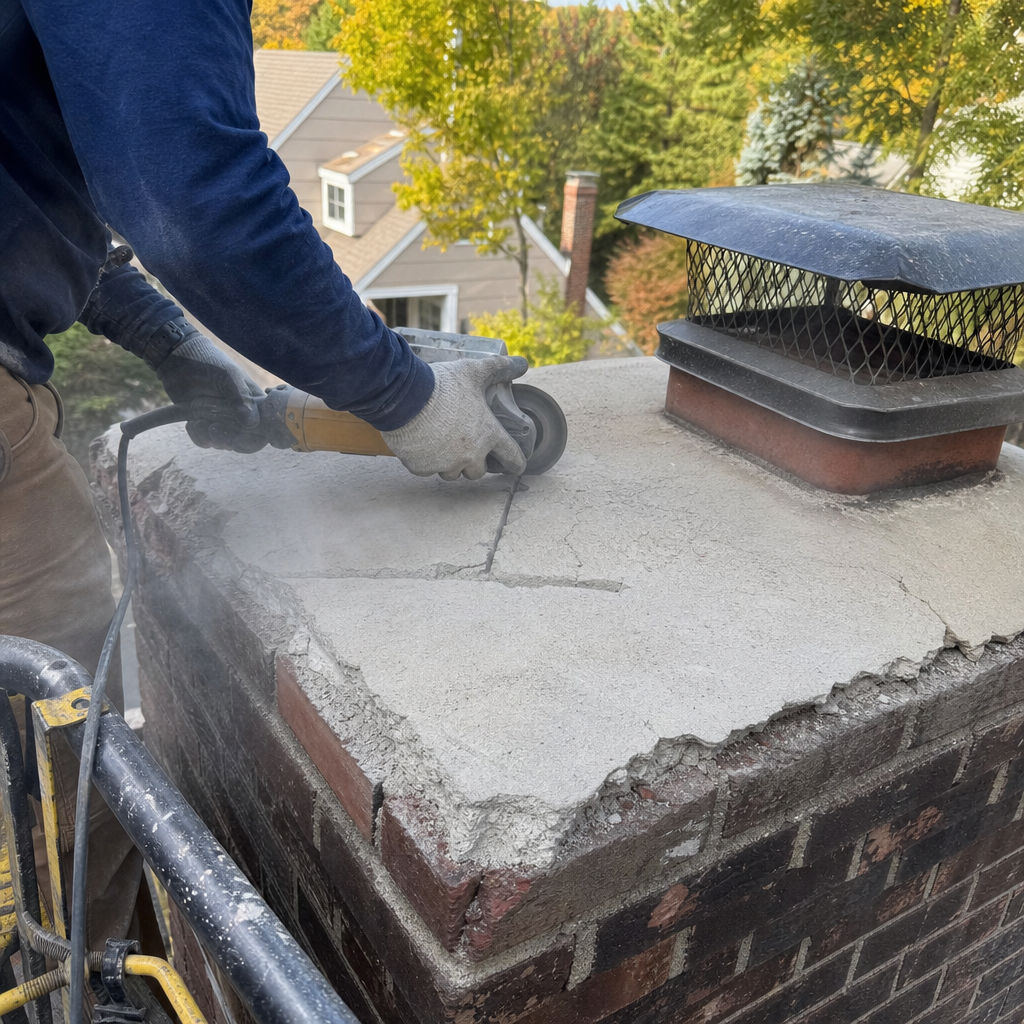
Crown repair is where Pleasantville’s freeze-thaw cycle does its damage. Original coal-era clay crowns develop hairline cracks that widen every winter as water penetrates, freezes, and expands. We see this constantly in the older blocks — crowns that look intact from the ground but are fractured networks up close. Our crown repair runs $850–$1,600: we cut back deteriorated edges, form a proper concrete or precast crown with minimum 2-inch overhang, and slope it for drainage. On heritage homes where preservation matters, we match crown profiles to original specifications.
Crown Coating
Crown coating is the preventive play that can add a decade to a sound but weathered crown. We use HeatShield’s polyester-based crown coating system — the same material specified by chimney professionals, not hardware-store elastomerics that peel in two seasons. In Pleasantville, where west-facing crowns take the brunt of weather coming off the hills, coating runs $650–$1,100 and buys time before full reconstruction becomes necessary. We apply it to clean, sound substrate; if the crown is too far gone, we’ll tell you straight and quote repair instead.
Why does my cap in Pleasantville keep shifting off the crown every winter?
Your crown surface has deteriorated to the point where anchor bolts can’t hold tension. In Pleasantville’s freeze-thaw climate, original crown mortar crumbles from the top down — the cap isn’t sliding, the substrate underneath it is disintegrating. We see this on hillside homes where wind-driven rain accelerates the damage. The fix is crown repair or coating to restore a sound anchoring surface, then proper reinstallation. Call (833) 719-7193 for an inspection.
Is a custom copper cap worth the investment for a Colonial Revival on Broadway in the historic district?
For a heritage home where architectural integrity matters, yes — a custom copper cap with proper patina and proportion looks correct where a galvanized utility cap looks like a repair. On Broadway’s Colonial Revivals, we spec Copperfield custom work with flanges that cover deteriorated crown edges and screen mesh that keeps wildlife out without visible hardware. Cost runs $1,400–$2,400 installed, but the lifespan is 30+ years versus 7–10 for standard steel.
Chimney Liner & Rebuild in Pleasantville
Chimney liner installation and rebuilds in Pleasantville typically run $2,800–$8,500 depending on scope, and most projects are completed in one to two days. If you’re seeing water stains around your flue, smelling smoke in upper rooms, or your heating contractor flagged “flue oversizing,” your chimney likely needs more than a sweep. In Pleasantville’s pre-1930 housing stock, liner work isn’t an occasional specialty — it’s the predictable outcome of converting coal-era chimneys to modern appliances. Our Chimney Liner & Rebuild page covers the technical details, but here’s what we do locally.
Stainless Steel Liner Installation
This is our most common liner job in Pleasantville, and for good reason. The village’s coal-era chimneys — those 12×12 and larger clay flues built for 1890s heating systems — are grossly oversized for today’s high-efficiency gas furnaces. A 4-inch or 5-inch DuraFlex stainless liner dropped inside the original flue restores proper draft velocity, eliminates acidic condensation pooling at the base, and meets current NFPA 211 standards. Stainless steel liner installation for a straight flue in Pleasantville typically runs $2,800–$4,200. On a typical Pleasantville Victorian near the village center, we’re in and out in a day, with the furnace back online by evening.
Flexible Liner Systems
Not every Pleasantville chimney runs straight. The hillside construction off Broadway and the offset flues in some Craftsman bungalows require a liner that can navigate bends without losing integrity. We use DuraFlex’s corrugated flexible sections for these applications, paired with Gelco sealant at the joints. Flexible liner with offsets or multiple bends runs $3,500–$5,500 in Pleasantville. The flexibility matters here — a rigid liner forced into an offset clay flue will gap at the turn, creating the exact leak you’re trying to solve.
Partial Chimney Rebuild
When the flue tiles have collapsed or the mortar joints have spalled beyond repointing, a liner alone won’t suffice. We see this most often on north-facing chimneys in Pleasantville, where decades of freeze-thaw cycling have destroyed the bond between wythes. Our partial rebuilds restore the structural shell — typically from the roofline up, or from the shoulder to the crown — using matching brick where possible, then install the new liner in a sound chimney. Partial rebuild with new liner in Pleasantville runs $5,500–$8,500. Anthony Perez oversees the masonry personally; he’s not subcontracting your rebuild to a crew you’ve never met.
Why do Pleasantville chimneys from the coal era need a reline rather than just a cleaning?
The original 12×12 or larger clay flues were built for coal-burning temperatures and airflow volumes that modern gas furnaces never reach, so exhaust moves too slowly, condenses into acid, and destroys the liner from inside — cleaning removes creosote but can’t fix an oversized, corroded flue. In Pleasantville’s pre-1930 housing stock, this mismatch is present on virtually every chimney; a cleaning call here almost always surfaces a relining conversation that wouldn’t happen in newer construction.
How long does a stainless steel liner installation take on a typical Pleasantville Victorian?
Most straight-flue stainless installations in Pleasantville’s two-story Victorians are completed in a single day, with the heating system back online by evening. Jobs on Colonials with taller flues or offset bends — common on the hillside streets — may extend to a second day for proper measurement and sealing. We schedule furnace downtime with you; you’re not left without heat overnight.
Brands We Service in Pleasantville
We install DuraFlex stainless steel liners, HeatShield cerfractory resurfacing systems, and Gelco sealants on Pleasantville jobs — the same product lines specified by chimney industry professionals, not hardware-store substitutes. We also stock Copperfield caps and custom fabrication components for the non-standard flue sizes common in this village. Most parts are on our truck or available next-day, so we’re not waiting on supply houses while your chimney sits open. See our brands for the complete list.
Pricing for Chimney Cleaning in Pleasantville, NY
| Service | Typical range in Pleasantville |
|---|---|
| Level 1 Inspection with Annual Sweep | $180 – $260 |
| Level 2 Inspection with Video Scan | $320 – $450 |
| Creosote Removal (Stage 1–2) | $200 – $280 |
| Glazed Creosote Removal (Stage 3) | $350 – $500 |
| Gas Fireplace Tune-Up & Inspection | $180 – $320 |
| Wood-Burning Fireplace Cleaning & Inspection | $220 – $280 |
| Mortar Repointing (standard chimney) | $1,200 – $2,800 |
| Spalled Brick Replacement (localized) | $450 – $1,100 |
| Chimney Waterproofing + Crown Seal | $800 – $1,400 |
| Flashing Repair/Replacement | $650 – $1,200 |
| Stainless Steel Liner Installation (DuraFlex) | $2,200 – $3,800 |
| Partial Chimney Rebuild (upper courses) | $2,800 – $5,500 |
Costs in Pleasantville run toward the higher end of regional averages for two reasons: the prevalence of two-chimney homes with dual flues requiring separate attention, and the near-certainty of liner assessment work on coal-era systems. We inspect first, explain what we find, and quote the full scope before starting work. Estimates are free.
Neighborhoods We Serve in Pleasantville
We work throughout Pleasantville’s ZIP codes 10570, 10571, and 10572, from the village center out to the hill streets. Most calls are scheduled within 24–48 hours, with fall pre-heating season our busiest window.
- Village Center / Railroad District (near Metro-North station)
- Bedford Road hillside area
- Washington Avenue corridor
- Broadway historic district
- Manville Road vicinity
Service Area — Cities Near Pleasantville
We regularly travel to chimney jobs in Pleasantville, NY, Briarcliff Manor, NY, Sleepy Hollow, NY, Tarrytown, NY, Ossining, NY, and North Castle, NY. If you’re in southern Westchester County and your chimney was built before 1950, we’ve likely worked on a house with the same flue configuration as yours.
Serving Pleasantville, NY — Our Local Coverage Area
We’re based nearby and serve all of Pleasantville, NY. The map shows the Pleasantville coverage area; if your address is on it, we can help.
Also serving nearby: Pleasantville, NY, Briarcliff Manor, NY, Sleepy Hollow, NY, Tarrytown, NY, Ossining, NY, North Castle, NY.
FAQs About Chimney Cleaning in Pleasantville
We typically schedule Pleasantville appointments within 24–48 hours, and often same-day during September and October when homeowners are preparing for burning season. We’re based in Connecticut and make the run down regularly — the Merritt Parkway to the Saw Mill River Parkway puts us in your driveway without the delays of cross-metro traffic.
Most routine chimney sweeping and minor cap or crown repairs don’t require permits in Pleasantville, but liner installations, rebuilds, and structural modifications typically do. We handle the permit research as part of our project planning and will tell you upfront if your job triggers a building department filing. We’ve worked with Westchester County’s requirements long enough to know which jobs need paperwork and which don’t.
Yes — we’ve worked in Pleasantville co-op buildings and HOA-governed communities. We coordinate access with building management, follow any exterior work rules, and provide the documentation your board may require. The key is scheduling during approved work windows and protecting common areas during material transport. Call (833) 719-7193 and we’ll walk through your building’s specific requirements.
What happens when you call
- 1A real person answersNo phone trees — talk to a local chimney cleaning pro.
- 2You get an upfront price rangeHonest numbers before anyone is dispatched. No surprises.
- 3We come out and measureLicensed & insured, at a time that suits you — the visit and the quote are both free.
- 4You get the price in writingLine-itemed, yours to keep, and nothing starts until you say go.
What Pleasantville Customers Say
"Licensed, insured, and he had the paperwork on him when I asked. You'd be amazed how often that's a problem."
— Alejandro Rodriguez"Level two inspection before we bought the house. The report was detailed enough to use as a negotiating point and he explained every photo in it."
— Brian Hayes"Drop cloths everywhere, HEPA vac, and not a speck of soot on the carpet. I'd been dreading the mess for nothing."
— Rosa Torres