
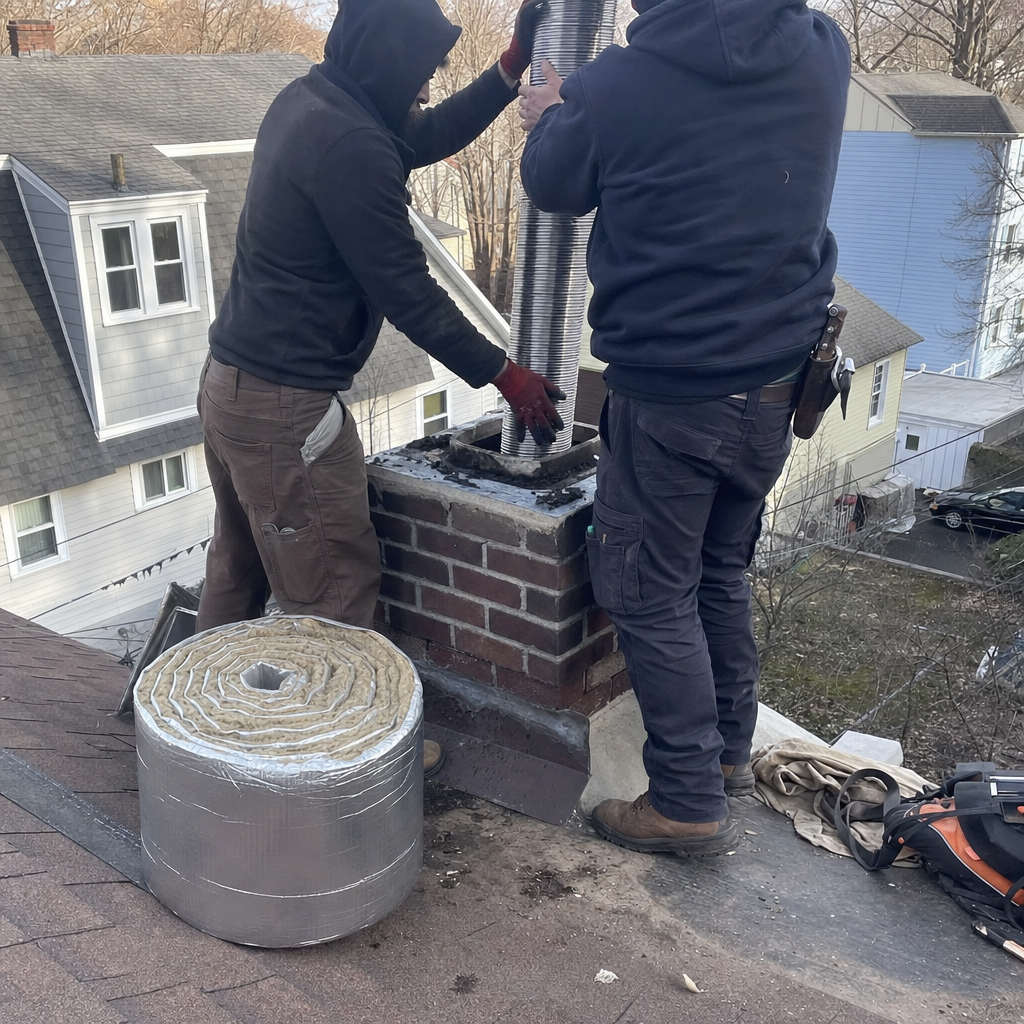
Chimney Liner Installation Cost in Connecticut: What You’ll Actually Pay
Chimney liner installation in Connecticut typically costs between $2,500 and $5,500 for a standard residential job, with most homeowners in Hartford, New Haven, and Fairfield counties landing in the $3,200–$4,200 range. Call (833) 719-7193 for a free estimate — Anthony Perez, our owner and lead technician, measures every flue personally before quoting. The final price depends on your flue’s condition, the liner type your appliance requires, and how much debris from old clay tile needs clearing first.
Last October, Anthony climbed onto a roof in West Hartford’s Elmwood section and found what we’ve come to expect in Connecticut’s older neighborhoods: a 1920s brick chimney with original clay flue tiles that had cracked diagonally from decades of oil-fired heating cycles, then been partially patched with a too-small flex liner during a 2005 gas conversion. The homeowner had three quotes, none of them for an affordable chimney liner & rebuild in Connecticut. None mentioned the six feet of crumbling tile blocking the smoke chamber. That’s the gap between a liner price and a liner job — and in this state, that gap is wider than most.
Why Connecticut’s Housing Stock Makes Liner Work More Complex
Connecticut didn’t build new housing at the pace of southern states. We renovated. Between 1990 and 2010, thousands of homes from Bridgeport to Bristol converted from oil heat to natural gas or propane inserts — often without proper relining. Gas appliances demand correctly sized liners for proper draft and condensation control. An undersized liner runs too cool, causing acidic condensation that eats mortar from the inside. A missing liner venting into an unlined masonry flue is a carbon monoxide risk that won’t show itself until it’s serious.
We see this pattern constantly: a homeowner in New Britain’s Walnut Hill neighborhood buys a house with a “working fireplace,” schedules an inspection, and discovers their gas insert has been venting into a 120-year-old terra cotta flue with no liner at all. The installation cost isn’t just the liner — it’s the remediation of what the previous shortcut left behind.
Our Chimney Liner & Rebuild work starts with a level II internal inspection using video scanning. Anthony runs the camera himself — he’s the one on your roof, not a subcontractor — and we don’t quote liner installation until we’ve documented what we’re working with.
The Three Liner Types: Real Costs and When Each Fits
Not every chimney needs the same solution. The liner type drives both performance and price, and the wrong choice means doing the job twice.
| Liner Type | Typical Cost Range (CT) | Best For |
|---|---|---|
| Stainless Steel Flex (DuraFlex) | $2,500 – $4,200 | Most gas and wood-burning retrofits; offsets and bends; standard flue heights |
| Rigid Stainless Steel | $3,200 – $5,000 | Straight, tall flues; maximum draft efficiency; wood stoves and high-output appliances |
| Cast-in-Place (HeatShield) | $4,500 – $7,500 | Structurally compromised flues needing reinforcement; historic preservation requirements |
We install DuraFlex stainless steel flex liners as our standard — professional-grade with tighter seam tolerances and a longer warranty than contractor-grade alternatives you’ll find through general supply houses. For flues with significant structural damage, we use HeatShield cast-in-place systems that essentially create a new masonry flue inside the old one. Anthony’s made the call to spec HeatShield on jobs in Stamford’s Springdale area where the clay tile was too deteriorated for any insert-based solution.
Rigid stainless makes sense when the flue is straight and tall — think Colonials in Litchfield County with minimal offset — but most Connecticut chimneys have some bend or narrowing from decades of settling. Flex handles that reality without custom fabrication delays.
What Actually Drives Your Price Up or Down
The table above is a starting point. These factors move you within or beyond those ranges:
- Flue height: Every additional foot above two stories adds material and labor. A three-story Victorian in Torrington runs higher than a ranch in East Hartford.
- Offset angles: Chimneys that jog to avoid a staircase or structural beam need careful navigation. Sharp offsets in pre-1950s construction can add $400–$800.
- Debris removal: Extracting collapsed clay tile, creosote buildup, or old mortar chunks from the smoke chamber takes time and proper disposal. We’ve pulled fifty pounds of material from a single flue in Waterbury’s Town Plot neighborhood.
- Top plate and cap: Some quotes separate these; ours includes them when they’re part of a complete system. A proper top plate seals the liner to the chimney crown, and a Gelco or Olympia Chimney cap keeps water and animals out. Ask whether your quote includes both.
- Appliance connection: Gas inserts and wood stoves require precise collar connections with proper torque specs. A loose connection leaks exhaust. An overtightened one cracks the appliance.
Eight years specializing exclusively in chimney work means we’ve seen the patterns. Anthony can usually estimate flue height and offset difficulty from the exterior, but the camera inspection confirms what the brick won’t tell you.
Why Liner Installation Isn’t a DIY Project
We get this question directly, especially from handy homeowners in Connecticut’s more rural towns — Andover, Hebron, the kinds of places where people fix their own tractors. Here’s the straight answer: chimney liner installation requires measurement to the quarter-inch, torque specifications on every connection, and verification that the liner is properly seated on the appliance collar. Done wrong, you get backdrafting, carbon monoxide infiltration, or a failed inspection when you sell the house.
Connecticut municipalities enforce the NFPA 211 standard, and most towns require a permit for liner installation with a follow-up inspection. Anthony’s handled enough of these to know which inspectors want to see the video documentation, which want physical access to the connection point, and which towns have added their own requirements beyond the state code. That’s not information you find in a manual.
We’d rather give you the straight answer on the roof than a comfortable one at the bottom of the ladder. If your flue is straightforward and your skills are genuinely advanced, you might handle the physical insertion. The connection, sealing, and compliance verification are where the risk lives.
How Our Process Works
Every liner installation we handle follows the same sequence Anthony developed over eight years and 800+ completed jobs:
- Level II inspection with video: We document the flue’s interior condition, measure exact dimensions, and identify any structural concerns before quoting.
- Appliance-specific sizing: Your gas insert, wood stove, or open fireplace requires a specific liner diameter for proper draft. We size to the appliance manufacturer’s specification, not guesswork.
- Material selection: DuraFlex for standard retrofits, rigid stainless for straight high-performance applications, HeatShield for structural rebuild scenarios.
- Installation and connection: Anthony leads this personally — he’s the one on your roof, not a seasonal hire.
- Post-install verification: We run the camera again, test draft performance, and provide documentation for your records and any municipal inspection.
From annual sweep to full rebuild, we handle the complete chimney lifecycle. That matters when your liner job reveals crown damage or smoke chamber deterioration that needs addressing before the system is truly safe.
What Connecticut Homeowners Should Know About Timing
Chimney work in Connecticut has a seasonal rhythm. September through November, everyone’s scrambling before first fire. Anthony’s calendar fills eight weeks out during peak season. Scheduling your inspection in spring or early summer means more flexibility and often faster permit turnaround from towns whose building departments aren’t flooded with requests.
That said, if you’re experiencing draft problems, moisture in the firebox, or a failed home inspection, we prioritize safety calls. We’ve done emergency liner replacements in February when a Westport homeowner discovered their gas boiler was venting into a cracked flue during a home sale.
FAQs
Most homeowners pay between $3,200 and $4,200 for a standard stainless steel flex liner installation, with simpler jobs starting around $2,500 and complex cast-in-place work reaching $7,500 — see our 2026 chimney liner & rebuild cost guide for Connecticut for full pricing breakdowns. The exact price depends on flue height, debris removal needs, and whether your appliance connection requires custom fitting. Call (833) 719-7193 — Anthony measures and inspects before quoting, so the price you get is the price for your specific chimney, not a generic estimate.
Repair only makes sense for minor, localized damage — a single cracked tile near the top, for instance, that we can address with HeatShield without full replacement. If your clay flue tile has multiple cracks, significant spalling, or missing sections, repair costs approach replacement while delivering inferior longevity. In Connecticut’s freeze-thaw climate, patched liners tend to fail within three to five years. We don’t recommend throwing good money at a system that’s already shown its limits.
Same-day installation is possible for straightforward jobs when we have the correct diameter liner in stock, but we don’t recommend skipping the inspection phase. Anthony needs video documentation of your flue’s interior to spec the right liner type and identify hidden complications. Most installations happen within one to two weeks of inspection, pending any required permits from your municipality. For urgent situations — failed inspections, active safety concerns — we expedite.
Gas appliances produce different exhaust than wood fires — wetter, more acidic, and requiring precise draft control. An unlined or improperly sized flue condenses moisture that deteriorates mortar from the inside, and gas conversions done without relining are one of the most common hidden hazards we find in Connecticut homes. “Worked fine” usually means “nobody has checked it properly.” A level II inspection reveals what appearances hide.
Get Your Exact Chimney Liner Installation Cost
We’ve installed DuraFlex liners in chimneys from Greenwich to Putnam, and every job started with Anthony on the roof with a camera and a tape measure — find chimney liner & rebuild services near you in Connecticut. No subcontractor. No guesswork. No comfortable answers that don’t hold up to inspection. If you’re researching chimney liner installation cost because you suspect your flue needs attention, call (833) 719-7193 today. We’ll schedule your level II inspection, show you exactly what we find, and quote the work your chimney actually needs — not a template price from a website.
Written by Anthony Perez, Owner & Lead Technician at Premier Chimney Cleaning Connecticut, serving Connecticut, CT.
What Our Customers Say
"Second time using them. Same guy, same good work."
— Keisha Mosley"Licensed, insured, and he had the paperwork on him when I asked. You'd be amazed how often that's a problem."
— Alejandro Rodriguez"Level two inspection before we bought the house. The report was detailed enough to use as a negotiating point and he explained every photo in it."
— Brian Hayes