
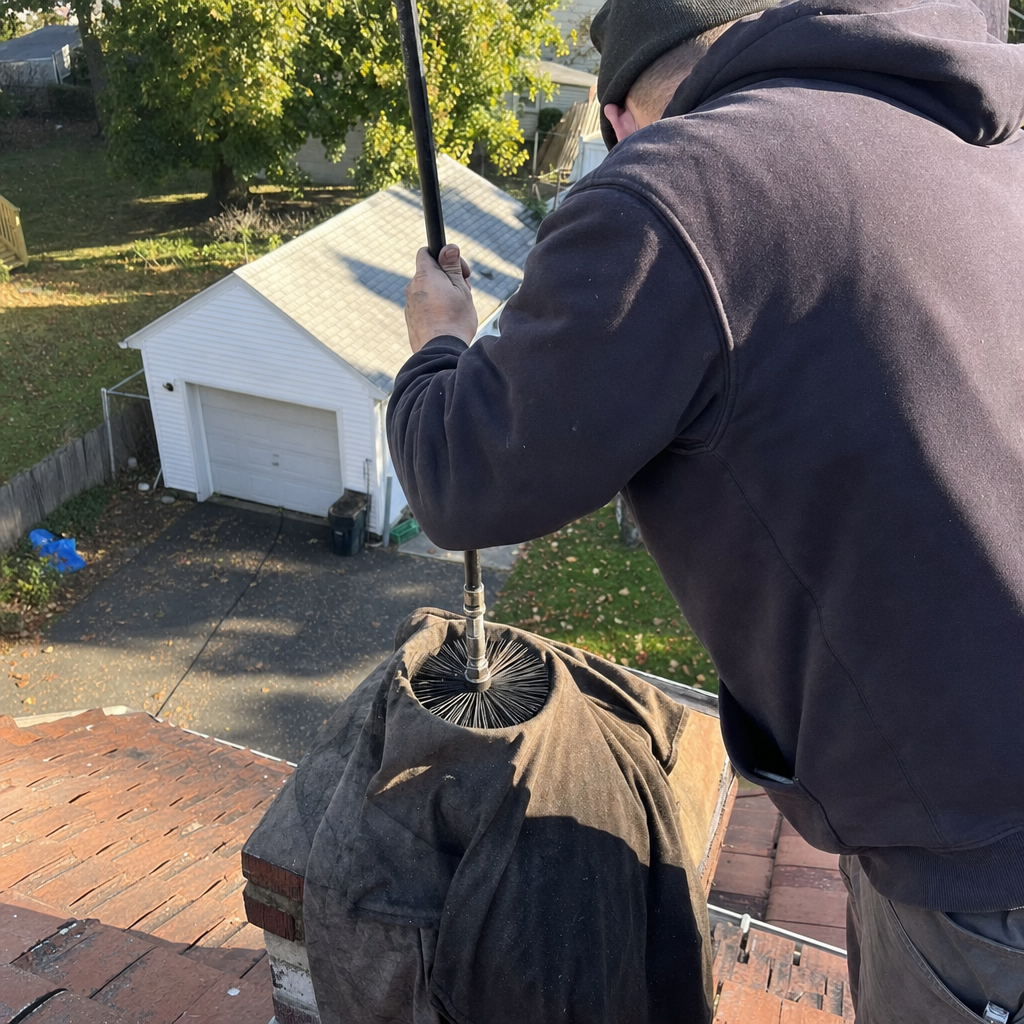
What Is Creosote Buildup? A Connecticut Chimney Technician’s Guide to the Real Causes
Creosote buildup is the accumulation of condensed, unburned hydrocarbons that coat the inside of your chimney flue when wood smoke cools before it can exit. It forms in three distinct stages — from dusty soot to tar-like residue to hardened glaze — and it’s the leading cause of chimney fires in Connecticut homes. If you’re seeing black flakes in your firebox or smelling a sharp, acrid odor when the fireplace isn’t in use, you’re already looking at active creosote accumulation. Call (833) 719-7193 and Anthony will tell you exactly which stage you’re dealing with.
Two Identical Fireplaces, Two Completely Different Chimneys
We cleaned two fireplaces on the same street in New Haven’s East Rock neighborhood last November — same colonial-era housing stock, same flue dimensions, same seasoned oak stacked beside each hearth. One homeowner had Stage 1 powder, light as coffee grounds, after two full winters of use. The other had Stage 3 glaze, black and glassy as obsidian, that could have ignited with a single spark. Same wood. Same chimney design. The difference was entirely in how they burned it.
That distinction — burn behavior over wood species, flue geometry over fireplace brand — is what most creosote explanations get wrong. They describe what creosote is without explaining why it accelerates or stalls. After eight years and hundreds of Connecticut flues, we’ve learned that creosote formation is less about what you burn and more about the temperature story your flue tells during and after each fire.
The Mechanics: Why Creosote Actually Forms
Creosote is not simply “the stuff that sticks to chimneys.” It’s a chemical event with specific preconditions. When wood burns incompletely — whether from insufficient oxygen, wet fuel, or a fire that’s been damped down — it releases volatile organic compounds, water vapor, and carbon particles in the smoke stream. If the flue temperature drops below roughly 250°F before these compounds exit the chimney, they condense on the cooler interior surfaces. Layer by layer, they polymerize into the substance we recognize as creosote.
The critical variable is flue temperature, not fuel type. A hot, oxygen-rich fire in a properly sized firebox sends gases up the flue fast enough that they never cool to condensation point. A smoldering, overnight-banked fire — the kind many Connecticut homeowners use to stretch a cordwood investment — keeps the flue in the exact temperature zone where creosote formation thrives: warm enough to produce smoke, cool enough to let it stick.
We’ve seen this pattern repeatedly in Connecticut’s older homes, particularly in neighborhoods like Fair Haven where Anthony grew up and still works regularly. The masonry mass of these century-old chimneys absorbs heat slowly and releases it slowly. That thermal inertia is great for draft stability but creates extended cooldown periods where creosote condenses long after the visible flames have died.
What Each Stage Looks, Smells, and Feels Like
- Stage 1 — Soot: Loose, dusty, black or dark brown. Brushes off easily with a standard chimney brush. Smells like a campfire that’s been rained on. This is what annual maintenance should find.
- Stage 2 — Tar: Crusty, flaky, or puffy deposits that cling to the flue wall. Requires more aggressive mechanical cleaning, often with a rotary system. Smells sharper, more acrid — you’ll notice it when the damper is open and the fireplace is cold.
- Stage 3 — Glaze: Shiny, hardened, enamel-like coating that’s become part of the flue surface. Cannot be removed by brushing alone. Smells like a road tar kettle on hot days. This is the stage that drives our Chimney Cleaning & Sweep calls in March and April, when homeowners finally look up the flue after a season of banking fires.
Connecticut’s Creosote Season: Why Shoulder Months Are the Worst
Connecticut’s climate creates a specific combustion problem that southern states don’t face: the extended shoulder season. October, November, March, and April — when nighttime temperatures drop to the 30s and 40s but daytime highs still reach the 50s and 60s — produce the most accelerated creosote buildup we see all year.
Here’s why. Homeowners light “take the chill off” fires: small loads, quick burns, dampers partially closed to keep heat in the room rather than letting it escape up the flue. These fires never establish the sustained flue temperatures needed to carry particulates out. The chimney stays cool, the smoke stays cool, and condensation happens within minutes of lighting the match. We’ve pulled Stage 2 buildup from flues in West Hartford and Middletown where the homeowner swore they “barely used the fireplace” — but they’d used it exactly wrong for six weeks of shoulder season.
The state’s housing stock amplifies this. Connecticut has one of the highest percentages of pre-1970 homes in the Northeast, many with original masonry chimneys that were never designed for modern airtight construction. When a homeowner tightens up the house with new windows and weatherstripping but leaves the fireplace operating as a vented appliance, the pressure dynamics change and the flue runs cooler still. Anthony has become the guy neighbors call specifically because he’ll tell you exactly what he found and why it matters, without padding the invoice.
The Hardwood Myth: Why Species Matters Less Than You Think
“I only burn oak” — we hear this on nearly every first-visit consultation, as if it were a vaccination against creosote. It isn’t. Moisture content and burn technique matter far more than species selection.
Green oak at 30% moisture content — wood that’s been split for a month or two and still hisses on the fire — produces substantially more creosote than properly seasoned pine at 15% moisture. The energy that should go into complete combustion instead goes into boiling water out of the wood. The resulting smoke is cooler, wetter, and heavier with unburned compounds. Yet the homeowner with the oak stack feels protected by reputation rather than by actual fuel quality.
We verify this with a moisture meter on every home inspection where the customer reports rapid buildup. The wood that tests over 25% moisture is almost always the culprit, regardless of whether it came from a red oak or a soft maple. Anthony’s recommendation is consistent: buy wood a year ahead, stack it off the ground with airflow on all sides, and test before you burn. The $20 moisture meter pays for itself in prevented buildup.
How Flue Geometry Changes Everything
The same burn behavior produces different creosote outcomes depending on chimney design. A straight, insulated stainless liner — brands like DuraFlex and Olympia Chimney that we install — maintains flue temperature from firebox to cap. The smoke doesn’t have time to cool and condense. An unlined masonry flue in an exterior chimney, by contrast, bleeds heat through three sides of brick and mortar. By the time the smoke reaches the top, it’s already deposited significant creosote on the upper third of the flue, where the chimney is coldest.
We’ve documented this with inspection cameras. In exterior chimneys on north-facing walls — common in Connecticut’s older neighborhoods — the upper flue often shows Stage 2 or 3 buildup while the lower section reads Stage 1. The temperature gradient, not the fire itself, created the differential. This is why we always recommend liner evaluation when we’re called for repeated rapid buildup. A Gelco or Copperfield liner system can transform a creosote-prone chimney into one that stays clean between annual sweeps.
What Removal Actually Requires: Stage by Stage
Not all creosote responds to the same treatment. Our Chimney Cleaning & Sweep in Connecticut process identifies which stage is present and selects the appropriate method — because sweeping Stage 3 without chemical preparation just polishes it.
| Stage | Appearance | Removal Method | Time Required |
|---|---|---|---|
| Stage 1 | Dusty, loose soot | Standard rotary brush sweep | 45–60 minutes |
| Stage 2 | Flaky or puffy tar deposits | Rotary system with specialized chains or chemical treatment | 1–2 hours |
| Stage 3 | Hardened, glazed enamel | Chemical application + follow-up sweep; may require multiple visits | 2–3 hours initial; return visit typical |
Stage 3 glaze is where we have a different conversation with the homeowner. If the buildup has reduced flue diameter significantly, or if the glaze has penetrated cracked mortar joints, cleaning alone doesn’t restore safety. We may recommend a HeatShield resurfacing application or a full liner install with Famco components — not to upsell, but because a polished glaze surface still presents fire risk. I’d rather give you the straight answer on the roof than a comfortable one at the bottom of the ladder.
Key Takeaways
- Creosote forms when flue gases cool below condensation temperature before exiting — low, slow fires are the primary cause, not wood species
- Connecticut’s shoulder seasons (October, November, March, April) produce the worst buildup because “chill-off” fires run cool flues
- Stage 1 is manageable with annual sweeping; Stage 2 requires more aggressive treatment; Stage 3 glaze demands chemical intervention and possible liner work
- Moisture content matters more than hardwood vs. softwood — test your wood with a meter
- Exterior masonry chimneys in older Connecticut homes are inherently more creosote-prone due to heat loss through brick
FAQs
Look for black flakes or powder in the firebox, a sharp acrid smell when the fireplace is cold, or visible tar-like deposits on the damper. If you can reach up past the damper and feel rough, crusty, or shiny black material on the flue walls, you have active buildup regardless of when you last swept. Call (833) 719-7193 for a camera inspection — estimates are free, and we’ll show you exactly what stage you’re dealing with.
Stage 1 soot can sometimes be reduced with proper tools and access, but Stage 2 and all Stage 3 buildup requires professional equipment and chemical treatment that isn’t available to homeowners. More critically, without a camera inspection you can’t see the full flue length or identify cracked tiles, liner gaps, or hidden glaze deposits that create fire risk. For eight years we’ve been called after DIY attempts that missed the actual problem — it’s not worth the gamble. Call (833) 719-7193 and we’ll handle it properly.
The National Fire Protection Association recommends annual inspection for all wood-burning systems, and in Connecticut’s climate we endorse that as a minimum. Homes that burn shoulder-season fires or bank overnight fires should consider mid-season checks, particularly if you’re noticing odors or draft changes. Our 800+ homeowners have reviewed us with a 4.7-star average, and the most common feedback is that they wish they’d called sooner. Annual sweeping — our Best Chimney Cleaning & Sweep in Connecticut, CT — by Anthony, who leads every job personally, catches Stage 1 before it becomes Stage 3.
Early cleaning is dramatically less expensive. Understanding Chimney Cleaning Cost in Connecticut, CT helps homeowners plan ahead: a standard Stage 1 sweep runs a fraction of the cost of Stage 3 chemical treatment, and either is trivial compared to a chimney fire that damages liner, masonry, or surrounding structure. From annual sweep to full rebuild, we handle the complete chimney lifecycle — but we’d rather keep you in the annual sweep category. Call (833) 719-7193 for upfront pricing on your specific situation.
When to Call Premier Chimney Cleaning Connecticut
If you’re smelling acrid odors, seeing flakes in the firebox, or simply can’t remember the last time a technician put a camera up your flue, it’s time. Anthony Perez leads every job personally — he’s the one on your roof, not a subcontractor — and he’ll tell you exactly what he found and why it matters. Eight years, one specialty, and 800+ Connecticut homeowners have reviewed our work. If you’d rather have it looked at, Premier Chimney Cleaning Connecticut offers Affordable Chimney Cleaning & Sweep in Connecticut, CT with a no-pressure assessment — call (833) 719-7193.
Written by Anthony Perez, Owner & Lead Technician at Premier Chimney Cleaning Connecticut, serving Connecticut, CT.