
How Often Should You Clean Your Chimney in Connecticut? The Real Interval Depends on What You Burn and How Hard You Burn It
Most chimneys in Connecticut need professional cleaning once per year, but households burning wood as primary heat should schedule a mid-season inspection after the third cord of hardwood — roughly January — because our seven-month heating season pushes more burn hours through the flue than national averages assume. If you’re burning gas or oil with occasional fireplace use, annual inspection with light cleaning typically suffices. For a precise read on your own system, call Premier Chimney Cleaning Connecticut at (833) 719-7193 — estimates are free, and Anthony Perez personally evaluates every flue he works on.
Why the “Once a Year” Rule Falls Short for Connecticut Burners
We hear it constantly from homeowners in Hartford, New Haven, and up through the Litchfield Hills: “I was told clean it once a year and I’m fine.” If you’re unsure whether your chimney actually needs attention, review these Signs your Chimney Needs Cleaning in Connecticut, CT. That baseline comes from the National Fire Protection Association, and it’s not wrong — it’s just built around a national average that doesn’t account for how hard Connecticut households work their chimneys.
Our heating season runs October through April, often stretching into May at elevation. A family in Bristol burning four cords of seasoned oak through that span is putting roughly double the combustion byproducts through their flue compared to a household in Virginia with a three-month burn window. The calendar doesn’t know how much wood you’ve burned. Your flue does.
Anthony Perez, our owner and lead technician, grew up in New Haven’s Fair Haven neighborhood and learned this distinction the hard way during his apprenticeship — inspecting a chimney in Meriden that had been “cleaned last October” but had already developed Stage 2 creosote by February because the homeowner was burning two cords a month to offset oil costs. The calendar said safe. The flue said otherwise.
The Creosote Staging Model: What Actually Builds Up in Your Flue
Understanding What Is Creosote Buildup? (Connecticut, CT) in stages gives you a practical mental model tied to wood consumption, not an arbitrary date. Here’s how it progresses in the field:
- Stage 1 (Soot/Dust): Appears after roughly one cord of hardwood burned. Powdery, light-colored, brushes away easily during a standard Chimney Cleaning & Sweep. This is normal and manageable.
- Stage 2 (Tar Flakes): Develops after 2–3 cords without cleaning. Dark, crunchy, porous layers that require more aggressive mechanical removal. Still manageable, but the job takes longer and costs more.
- Stage 3 (Glaze): The dangerous one. Hard, shiny, nearly impermeable coating that forms after prolonged heavy burning without intervention. Glaze creosote ignites at lower temperatures and burns with explosive force — this is the stage that makes the evening news in Connecticut every winter.
We’ve pulled Stage 3 glaze from chimneys in Waterbury that were “cleaned annually” by budget sweeps who never ran a camera. The homeowner followed the rule. The rule didn’t fit the burn rate.
Your Personal Cleaning Interval: A Simple Decision Matrix
Use this framework to estimate your actual interval based on fuel type and burn habits. These numbers come from eight years of inspecting Connecticut flues, not generic guidance:
| Fuel Type | Burn Pattern | Recommended Interval | Mid-Season Check? |
|---|---|---|---|
| Seasoned hardwood | Primary heat source (3+ cords/season) | Pre-season sweep + January inspection | Strongly recommended after 3rd cord |
| Seasoned hardwood | Supplemental heat (1–2 cords/season) | Annual pre-season sweep | Consider if burning 2+ cords |
| Gas fireplace/logs | Regular weekend use | Annual inspection, light cleaning every 2–3 years | No — but inspect liner annually |
| Gas heating appliance | Daily winter operation | Annual inspection mandatory | No — moisture and corrosion checks suffice |
| Oil heating | Daily winter operation | Annual inspection + cleaning | No — but watch for sulfuric acid damage |
| Pellet stove | Daily use | Annual sweep + ash pan maintenance | Check venting monthly yourself |
These intervals assume normal operation in Connecticut’s climate. Burning unseasoned wood, operating a stove or insert at low airflow for overnight burns, or using your fireplace during power outages — common in rural Tolland and Windham counties — accelerates creosote formation significantly.
The Connecticut-Specific Factors That Shorten Your Interval
Several local realities push Connecticut chimneys harder than the national baseline assumes:
Extended heating season: Our shoulder months — October and April — often see active burning when other regions have shut down. That’s 15–20% more annual burn hours before you account for any mid-winter cold snaps.
Older housing stock: Connecticut’s pre-1970 homes, concentrated in Bridgeport, New Britain, and the former mill towns of the Naugatuck Valley, frequently have unlined or partially lined chimneys. These systems accumulate creosote faster and tolerate less buildup before becoming hazardous. We’ve replaced more DuraFlex liners in 1920s colonials than in any other housing type.
Wood moisture reality: Ideally you burn at 20% moisture or below. In practice, Connecticut’s humid summers and early falls mean even properly stacked wood often enters the season at 22–25%. That extra moisture means cooler flue temperatures, incomplete combustion, and faster creosote deposition. Anthony checks moisture content on every wood-burning job — it’s often the first explanation for premature buildup.
Coastal corrosion: Homes within ten miles of Long Island Sound — from Greenwich through Old Saybrook — see accelerated liner deterioration from salt air intrusion. Gas and oil appliances in these areas need more frequent liner inspection even when cleaning intervals stay standard.
The Gas Conversion Mistake We See Too Often
Since 2015, thousands of Connecticut households have converted from oil to natural gas, often with the understanding that “gas is clean” and chimney maintenance becomes optional. This is incorrect, and we’ve had difficult conversations with homeowners in Stamford and Norwalk who learned it the expensive way.
Gas combustion produces significant moisture — roughly one gallon of water vapor per 100,000 BTUs burned. That moisture condenses in cooler flue tiles, especially in shoulder seasons when the chimney hasn’t warmed thoroughly. Over time, this produces:
- Chloride salt deposits that corrode terra cotta flue liners
- Mortar joint deterioration between flue tiles
- Spalling (surface flaking) of the chimney interior
- Carbon monoxide pathway development through compromised masonry
The cleaning is lighter with gas — no creosote to speak of — but the inspection is arguably more critical because damage progresses silently. We use Olympia Chimney inspection cameras on every gas flue to document liner condition; the image quality lets Anthony show homeowners exactly what he’s seeing, not ask them to trust a verbal report.
What Happens When You Stretch the Interval Too Long
We’ve cleaned chimneys in Connecticut that hadn’t seen a sweep in four, six, ten years. The pattern is predictable, and the cost escalates nonlinearly:
A standard sweep in autumn runs $200–$350 for a straightforward system, though Chimney Cleaning Cost in Connecticut, CT varies with creosote severity. Add Stage 2 creosote, and you’re looking at $400–$600 for the mechanical removal time. Stage 3 glaze requires chemical treatment — we apply HeatShield’s glaze removal compound, let it dwell, then mechanically strip — pushing the job to $800–$1,200. If the glaze has damaged the liner or the chimney has caught fire previously (often undetected by the homeowner), you’re now discussing liner replacement with DuraFlex or Gelco stainless steel at $2,500–$5,000, or in severe cases, partial rebuild with Copperfield materials.
The January mid-season check that Anthony recommends for heavy wood burners? Typically $150–$250. It’s not a full sweep — it’s a camera inspection and spot cleaning to catch Stage 1 before it becomes Stage 2. The math is obvious if you’re burning serious cordage.
How to Tell If You’re Due Before the Calendar Says So
Even with our matrix, conditions vary. Watch for these indicators that your interval has shortened:
- Smoke backing up into the room: Often creosote narrowing the flue, or a bird nest in the cap — but the symptom is the same. Don’t burn again until inspected.
- Strong, acrid odor when the fireplace isn’t in use: Humid summer air interacting with creosote deposits. If you smell it, there’s enough buildup to matter.
- Black, shiny deposits visible from the firebox: That’s Stage 2 or 3 creosote within reach. What’s higher up is almost certainly worse.
- Reduced draft requiring you to open windows: Your chimney is choking. Stop using it.
- More than 1/4 inch of soot on the damper or smoke shelf: Visible accumulation means hidden accumulation, and the hidden stuff is harder to reach.
Anthony’s direct advice: if you’re unsure, err toward inspection. “I’d rather give you the straight answer on the roof than a comfortable one at the bottom of the ladder.” We’ve never had a homeowner regret an unnecessary inspection. We’ve had several regret the one they skipped.
What Professional Chimney Cleaning Actually Includes
A proper sweep from Premier Chimney Cleaning Connecticut isn’t a vacuum-and-go operation. Our process, developed over eight years and 800+ completed jobs, follows this sequence:
We start with exterior visual assessment — cap condition, crown integrity, brick and mortar inspection from ground and roof level. Anthony does this personally; there’s no crew chief interpreting photos later. We then run an internal camera inspection from the firebox to the cap, documenting flue tile condition, liner integrity, and creosote staging. Homeowners see what we see.
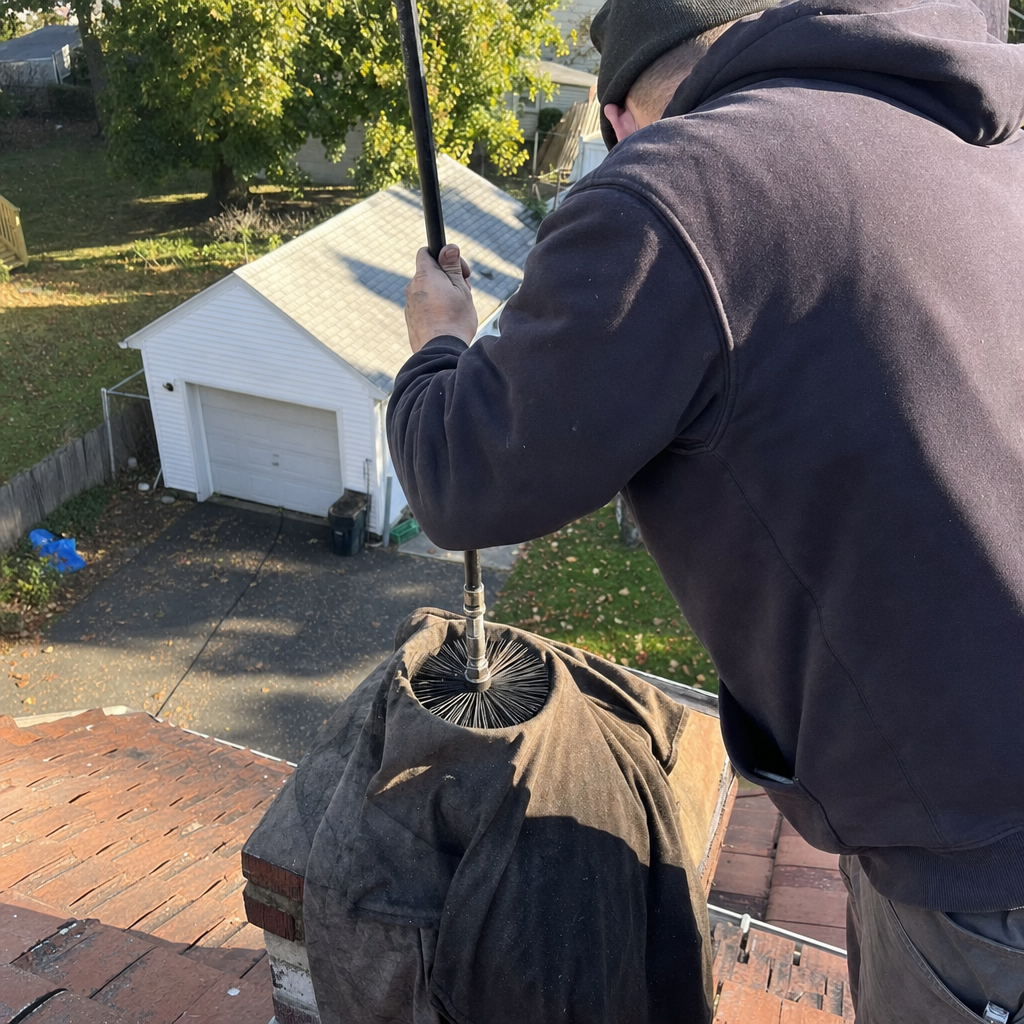
Mechanical cleaning follows with rotary brushes sized to your flue dimension, HEPA-contained debris removal, and smoke shelf scraping. For systems with HeatShield or other resurfacing products, we adjust technique to preserve the coating. Final camera pass confirms removal completeness, and we provide written documentation with photos for insurance or real estate purposes.
The entire process takes 60–90 minutes for a standard fireplace flue. Inserts and freestanding stoves require additional disassembly time. We’re transparent about scope before we start — no surprise charges because “it was worse than we thought.”
FAQs
An Affordable Chimney Cleaning & Sweep in Connecticut, CT for a wood-burning fireplace typically runs $200–$350, with heavy creosote removal adding $200–$400 and gas flue inspections starting around $175. Call (833) 719-7193 for an exact quote — estimates are free, and Anthony Perez evaluates every job personally.
DIY brush kits cost $50–$150 but cannot safely address Stage 2+ creosote, inspect liner condition with a camera, or certify compliance for insurance purposes — professional cleaning pays for itself in documented safety and damage prevention. Call (833) 719-7193 to discuss what’s actually involved for your system.
During peak season (September–November), we typically book 1–2 weeks out; mid-season and emergency slots open more quickly, and we maintain a cancellation list for urgent situations. Call (833) 719-7193 to check current availability — we’ll be straight about timing.
Gas fireplaces need annual inspection for moisture damage and liner corrosion, though full “cleaning” is lighter than wood systems — the critical service is camera-documented condition assessment, not debris removal. Call (833) 719-7193 to schedule; we use Olympia Chimney inspection systems for clear documentation.
If you’d rather have it looked at, Premier Chimney Cleaning Connecticut offers a no-pressure assessment anywhere in Connecticut — call (833) 719-7193.
Written by Anthony Perez, Owner & Lead Technician at Premier Chimney Cleaning Connecticut, serving Connecticut, CT.